Squirrel Eyes by Scott S. Phillips

Scott Phillips posted this video of The Blue Man, which is the short film the protagonist made as a kid in the book, and Scott made in real life as a kid in, um, real life. Super 8mm done by kids about a post-apoc wasteland in the 70s! <3

….

Oh man, Squirrel Eyeswas so fun to read. I didn’t really know what to expect, because I’ve seen a few of Scott’s movies, which are definitely more on the grindhouse end of things. Fight scenes, blood splatter, some boobies, maybe some zombies, and off they go. They’re fun, if you are into zombies, boobies, and/or blood splatter, but maybe aren’t for everyone. I don’t mean that as a dis; genre tastes are what they are. 

This is not a grindhouse book, whatever the hell that might mean. This is an affecting, anecdotal story about dreams deferred. Our first person protagonist, Alvin, starts the story by slinking back to Albuquerque from LA after his girlfriend leaves him and his film-writing career goes to shit. He drunkenly hits on the idea of making it with his high school girlfriend as the way of getting his mojo back. This is an incredibly bad idea – we all know this – but it makes pretty perfect sense in the stew of shame and loss that Alvin is living in. He falls into re-making a short film that had been an aborted project as a teen, and the sections detailing the process have a lived-it feel & good physicality. 

Alvin’s voice is just fantastic, and the chapters read like personal anecdotes told by someone who is an excellent anecdotalist. I have this friend Mewes who is the master of the personal anecdote, and he has a couple that I beg him to tell me whenever he’s drunk enough. Many of them are from his time in the Peace Corps, and all of them center on vomit and/or diarrhea. At some point, you know he’s going to say, “So there I was…” I’m already giggling thinking about them, and I’m sorry I will not relate them right now, because I’ll just botch them.

Anyway, Alvin reminds me of Mewes, not because of stories of vomit – although there is one funny interlude in this book about the technicolor yawn – but because he’s got this great conversational style that knows how to take the folk idiom and twist it. (One example I can think of without looking it up: “She was built like a brick shithouse full of bobcats.” Hahaha! Wonderful extension of the brick shithouse folk metaphor.) He’s got great timing, and the chapters often end with a nice knife twist, not one that draws readerly blood in an act of cruelty, but one intended to make you look at the situation in a slightly different way. 

I found myself laughing a lot while I read this, which is funny on exactly two levels, bitches. It was funny because it was funny, of course, but then it was funny because there’s this profound core of loss and pain in this story. The sections that deal with Alvin’s family – his mother and brother – rang especially with a kind of truth of disappointment and love, and hung uneasily with the ways family can be wonderful and awful in the same moment. There’s this running gag where Alvin starts sobbing every time he gets into a shower – something about the running water unleashing the floodgates – and while this is written semi-comically, it’s that sort of Chekhovian comedy that is not funny at all

This is what kind of kicked the shit out me in the end: talent is not the same as success; and passion does not translate from one medium to another. I totally apologize for this dorky allusion, but I kept thinking of Browning’s “Andrea del Sarto” as I read this, especially at the end. Browning’s poem is one of his dramatic monologues, about a lesser know Renaissance painter named *cough cough* Andrea del Sarto. He’s a failure only of sorts, destined to be a footnote to Michelangelo, Raphael, da Vinci, but a powerful painter of his own. Browning writes del Sarto’s monologue as he begs his wife not to cuckold him again, but only in the most euphemistic of terms. The way he talks about his art with both deprecation and longing cleaves me: 

Ah, but a man’s reach should exceed his grasp,
Or what’s a heaven for? All is silver-grey,
Placid and perfect with my art: the worse!

Alvin’s a sort of novelistic Andrea del Sarto: a successful vision of loss and failure; conversational and complete on its own, but still bending to the incompleteness that is the lives of all of us who are not stunning geniuses of whatever form. Does that make any sense? It might not. I guess I’m trying to say that I liked how Alvin struggled, finding his joys in the wreckage, remembering what drove him to his life choices, the passions that drive him, etc. The ending was a little rushed for me – I feel like there was a missing scene or two, especially that final, missing confrontation with the ex-girlfriend – but it was otherwise a sensible ending. A good book. 

And a last note: I know Scott, and he sent me a copy of this book to read, for full disclosure. It was only available as an ebook at that point – this has changed – and this precipitated a huge crisis for me as I tried to make my phone into an ereader. A completely ridiculous amount of gnashing of teeth and emails ensued, until I thrust my phone on my friend Jeremy, and demanded he make the Nook application work. Success! I didn’t mind reading it on the little screen too much, but it ran down my batteries like crazy, and I still prefer paper. So there.

Steampunk! An Anthology of Fantastically Rich and Strange Stories

Steampunk! An Anthology of Fantastically Rich and Strange Storiesis a cromulent collection of short stories, though uneven like most (maybe all) multi-author collections. I do appreciate the emphasis by editor Kelly Link on steampunk stories outside of the now-iconic Victorian London steampunk setting. I like the thickly urban setting – it’s what drew me to the sub-genre in the first place – but I can get fiercely irritated with the way some steampunk fetishizes the upper class twit of the year with his goggles and laboratory that I sometimes find in that setting. So, to the individual stories.

“Some Unfortunate Future Day” by Cassandra Clare: Inoffensive piece of atmosphere that fails to say anything at all, cutting out right when the real narrative choices need to be made. The daughter of a mad scientist is abandoned by her father to go fight in some ill-defined war, leaving her in the care of Romantic talking dolls in a crumbling Gothic house. A soldier falls out of the sky, which leads to a lot of naive narrative imaginings from the girl, and then the obvious use of a Chekhovian timepiece and then…the end! It’s like a chapter cut out of a larger narrative where all the implications come to fruition in the next chapter. But the story is pretty enough, I guess, and the only thing I really hated was the entirety of Shakespeare’s Sonnet 64 used as an epigraph. Seriously, who does that for a short story? Ugh. 

“The Last Ride of the Glory Girls” by Libba Bray. I would absolutely kill for a Glory Girls novel, which is not to say this doesn’t function as a short story. Reminded me strongly of Firefly, with its frontier planet full of harsh religion and frontier cruelties, written in a stylized dialect that totally works. Pinkertons, train heists, girl bandits, divided loyalties: all the things that make Old West stories a hand-to-hand combat of colonialism. There is also arresting baptism by sludge sequence here, a very tactile metaphor for the industrial revolution, etc etc. 

“Clockwork Fagin” by Cory Doctorow. Very anecdotal story, told in the first person by a boy matriculating in an orphanage of children mangled in punk-shifted industrial factories. “Clockwork Fagin” is obviously a Dickens riff – Fagin was the antagonist in Oliver Twist – with its social consciousness and the plight of youngsters in the industrial machine. Full marks for being a story that doesn’t fetishize the corsets and monocles set, instead focusing on the organized rebellion of the working class. Workers of the world, unite! 

“Seven Days Beset by Demons” by Shawn Cheng. Seven deadly sins in comic form with perplexing steampunk ornament and terrible lettering. At least it’s short. 

“Hand in Glove” by Ysabeau S. Wilce. Too smart for her own good detective gets on the trail of a serial killer, despite an indigent man having already been convicted to hang for the murders. Some of the plot mechanics were unsuccessful – I didn’t like the mad scientists much – but the narrative voice is snappy, and the overall aims of the story worthy. The ways entrenched bureaucracies, like the police force, use and abuse science are always worth examining. 

“Ghost of Cwmlech Manor” by Delia Sherman. Not really to my taste, but a goodhearted little story. Cwmlech Manor is haunted by the ghost of the once mistress of the manor, killed in the English Civil War by Cavaliers looking for loot. The main character is a plucky girl type, who is pragmatic about her romanticism. 

Best of all, I loved the story that went with [Cwmlech Manor] – very romantic and a girl as the hero – a rare enough thing in romantic tales, where the young girls always act like ninnies and end up dead of a broken heart, often as not.

You can see the grammar is tortured, but the sentiment is neat. Her remark about the legend ends up describing her own story. Go girls. 

“Gethsemane” by Elizabeth Knox. A perplexing story, one with interesting themes that never came together satisfactorily for me. The setting on a Caribbean island (?) was cool, as were the racial themes: passing, folklore, even the old school non-Romerian zombie. But the plot ranged over too many characters, and shifted perspectives weirdly. I admit I just didn’t get it, but I suspect there was something here to get. 

“The Summer People” by Kelly Link. Editor, edit thyself! Which is a bitchy thing to say, and I don’t really mean it. This isn’t a bad story at all, but its steampunk elements are so nominal as to make it feel like a shoehorn job in the collection. It’s not even so much that I don’t think magic has a place in steampunkery – there’s a growing body of dash-punk work out there that shifts history by magic instead of technology – but that this magic doesn’t really do that. That said, I enjoyed this story about a girl tasked with minding the summer people, who we first are to understand are summer vacationers to her poor, rural setting. I liked her relationship with a vacationer-turned-resident, a girl who is slightly enamored of all the folksy poverty, which is of course only folksy to outsiders. The ending is a bit obvious, and the denouement more truncated than I would like, but a good story anyway. Fine, Kelly, you win. 

“Peace in Our Time” by Garth Nix. I’m on record as a Nix fan, but the more I see of his short fiction, the more I think he shouldn’t write it. The narrative voice was daft and grated, and the characterization poor. It wasn’t so much a story as a situation, one that ended in a OH DO YOU SEE? reveal that hearkened to the hokiest of Twilight Zone endings. Bah. 

“Nowhere Fast” by Christopher Rowe. Another short story that ends right before it should get interesting, where the real conflicts are going to begin. I don’t feel as irritated by this as the Clare short story, because at least this world is aiming for something more than pretty but useless. This is one of those post-apocalyptic utopias that no one bothers to write anymore – two generations past peak oil in a fiercely local America. A boy in a car, of all things, shows up in town, which kicks over a bunch of anthills. Given how bound up in our national identity the automobile is, it was interesting to consider the American landscape without them. 

“Finishing School” by Kathleen Jennings. Another comic. Slender reimagining of the invention of flight, this time by a daughter of Scottish and Chinese parents who is stuck in an Australian school for girls. Nice metaphors of girlish exuberance. When a friend’s mom got divorced, she took Amelia as a middle name. We long for flight sometimes, and sometimes we should get it. 

“Steam Girl” by Dylan Horrocks. I think I’m going to call this one out as the stand out of this collection. A nerdy, chubby boy semi-befriends a poor, outcast girl. She tells him stories of Steam Girl, an obvious self-avatar grown long-limbed and beautiful in her pulpy imaginings. Horrocks has a good sense of the teenage outcast – not the romantic one, with his bangs in his eyes, but the real kind: uncomfortable in his body, clueless, and slightly horndoggish, but not in a particularly nasty or cruel way. Escapism is important for people who have something to escape from, and this story is so sensitive to that equation. 

“Everything Amiable and Obliging” by Holly Black. Fine, I guess, but I don’t think all the implications of the central metaphors here were considered, so I feel all squicky in the end. A girl falls in love with a house automaton, and her family tries to dissuade her from her love of the dancing instructor robot. He’s part of the hive consciousness of the house, and there’s a lot of shouting and stuff about loving robots designed to give you exactly what you want. That’s not the squick part for me. The squick part was when this was equated with the other girl’s lack of agency in her own relationships, and then my brain started shouting, but wait! Are we characterizing the working class as automata? Are we really saying girls lack agency? I can see where Black was going with this, I just don’t think it was thought out enough. 

“The Oracle Engine” by M. T. Anderson. A Roman steampunk story. And not modern Roman, but the Classical kind. Holy shit, but this was fun. Written in that gossipy historian’s voice, the one that relates a bunch of folklore and quotes the classics, and then pulls back demurely and says there isn’t any basis for that conjecture. I was fully expecting a Mechanical Turk at the center of this story, which, if you are not familiar with the concept, was a chess-playing engine invented in the 18th C, but turned out to be a dude hiding in a box and not an automaton at all. (Amazon has named it’s crowd-sourcing venture after this, and this enterprise is why capchas have gotten so freaking annoying.) That would have been neat, but the actual center of the story is so much cooler and weirder. GIGO. 

Oh, and also? The scientific ornament was brilliant. Archimedes almost invented calculus, for crissakes, and while there’s no guarantees that the lunatics of the Middle Ages wouldn’t have lost his discoveries – like they did with how to make concrete – had Archimedes’s discoveries become widely known, it is a fun thought experiment to consider.

Review: Walking Dead: Clear

Well, whoo boy, that is why I watch this show. Spoilers, as usual.

I’ve been slipping into bitching in the last couple episodes of the third season of Walking Dead. There’s been too much – what? – high level bullshit about society and human power structures and blah blah blah. Zombie stories can be attuned to this sort of thing. They are lifeboat situations with a leaking raft of incompatible people struggling for the oars, and while I think this sort of thing can be fun, I have been unimpressed so far with how that high level stuff has been dealt with this season. Or, really, ever on this show. It’s not even so much that I disagree, which I think I do, it’s that I think the whole question has been framed wrong.

But, Clear manages to hit all the interpersonal harsh realities that I love so very much about the end of the world. In fiction anyway; the world hasn’t ended yet for me. Rick, Michonne and Carl are in their lifeboat car when they drive past a hitchhiker on the road. They don’t even rubberneck, like we do at a car accident, and just the passengers even register what is going on on the edge of the road. They get hug up on a snarl, a single walker crushed under the edge of a vehicle, until the walkers all come, banging their hands on the glass. It’s iconic, in a way, inside and outside, same same. Rick rolls down the window, tells everyone to cover their ears, and it’s almost comic that we don’t see the zombie clearing sequence, just an aftermath of bodies in the grass.

Rick and Carl have a conversation about Michonne well within her earshot – it’s almost like the end of the world makes people stupid to the life happening just right there, and Clear is absolutely the first episode of Walking Dead to give Michonne something like a character and humor. You can see her thinking, I have to win this this kid, and when she does it is a revelation. Carl’s been doing the pre-teen of death thing for a while now, stalking off, being smarter than his elders, and when he does it here, it’s funny to see someone calmly play equal or confident. Of course it’s for Judith you’re doing this, Carl. Of course. And here is your rainbow consolation prize!

I am jazzed to see Morgan, whom we haven’t seen since the pilot, Days Gone Bye, when Rick stupidly called out to a walker in front of his house and Morgan’s kid hit him with a shovel. Morgan has obviously had a hard time of it, losing his son to his zombie wife, like there “wouldn’t be a reckoning,” as he says. Maybe this is a larger metaphor for Rick and the crazytown he’s been building, but it didn’t feel like it. It felt like two fucked up, traumatized people fighting hand to hand with grief, with each other and their simple likenesses and differences. It felt like what should be happening with the Governor but isn’t.

But here’s the thing that moved me about this episode. The opening shot is a sign, strung with ribbons, that reads, “Erin, we tried for Stone Mountain.” It’s facing the wrong way, so probably our protagonists never see it, and moments later, a walker with a bracelet that reads “Erin” bangs on the window of their car. Not so long ago I read Dead Inside: Do Not Enter: Notes from the Zombie Apocalypse, which was put together by the fine folks at Lost Zombies. The end of the world by needs is epistolary, the electricity gone, the computers bricks. We need to write our damage on the walls and signs, the last articulations that only humans can understand. Literacy is what separates us from the walkers; grief is something that can be written, and, pray hope, can be read.

So again, whoo boy, that was nice. Keep it up, Walking Dead.

Review: Walking Dead: I Ain’t a Judas

Spoilers, etc.

Post-apocalyptic stories often deal with wonkish logistical realities: where to get water and food, how to protect your body, how to skin a rabbit. This can be done well, like in Mike Mullin’s Ashfall, which tackles the physical realities of volcanic annihilation with tense, realistic detail. Or it can be done badly, like in the Autumn series by David Moody, which has a very serious “going to the bathroom” problem. Seriously, stop talking about searching the desks! Stop doing all that Mordorian walking! Gah. Now, I think one of the stupidest criticisms of any television program is “when do the characters go to the bathroom??” but I think post-apocalyptic settings almost beg the question. Hell, this is played for gags in Zombieland, what with Mark Zuckerberg’s whole quest to see a man about a horse without getting et.

It’s a Maslow’s triangle of needs brought down to the most bodily immediacy, and Walking Dead so far has made what I felt was reasonable gestures to the scrabbling hardship of securing basic needs, from making runs for formula to huntin’ and fishin’. More enterprising folk than I have put together google maps of the locations on Walking Dead, you know, with the usual caveats that many of these places are fictional to start. Sure, there’s been the usual “in all the crappy zombie-infested strip malls in Georgia, Merle finds Glenn and Maggie in this one??” but I respect that stuff has to happen, and too much logistical blather can get to the bathroom problem. But good golly, I Ain’t a Judas pretty much poops on logistics. And it does it with fucking Andrea, which, barf.

Andrea has been bugging the shit out me since her sojourn in Mayberry, although if I’m being fair, my irritation with her wide-eyed blonde routine is in some ways an outgrowth of my irritation with Mayberry. Because Mayberry has the opposite of a “going to the bathroom” problem; that place and its people make zero logistical sense. What are you eating?? Why doesn’t everyone get there are zombies everywhere?? Why does Milton (and, sidebar, is this an awful literary reference or not?) goggle when the Governor growls that “adolescence is a 20th century concept”? I mean, sure, I get that I’m supposed to think, OMG THE GUV IS EVIL TEH ASTHMATIC CHILDREN, and then have the revelation that Carl’s been gun-having for nearly two seasons ZOMG, etc. Which I’m going to resent, thank you.

Anyway, back to Andrea, and how much I hate her character. I guess since the writers offed Lori in a big gender specific gross out, they needed another girl to be ridiculously inconsistent and horrible. They’ve done such a crap job of differentiating the townspeople that I can’t even credit Andrea’s shouting about how there are “innocent people(!)” in Mayberry. Come on. (Also, what is up with Carol’s “bang and kill him” advice? Bad, bad writing.) In all the dumb shit she says, she does hit the occasional truth on the nose, like why are they trusting Merle with a gun? Seriously, good question.

But really, my biggest problem with this episode was the blithe treatment of the landscape here, certainly done so Andrea could play ambassador to the two groups, there and back again, jiggidy jig, but it’s sloppy and poor, and makes me nit-pick. Why aren’t the Rickocrats just clearing the walkers crashed into the yard? They took down the lot of them in an afternoon when they took the prison in the first place. I see that Tyreese is now hanging with the Governor, but, um, did we see them leave the prison? How far away are these places? Are there still herds? How many walkers are there? WHAT IS GOING ON?

The whole thing just frustrates me, and it frustrates me more because the writers have been setting up the parallels between Mayberry and the Prison (OH DO YOU SEE?) with such a sledge-hammer that they are smashing both logistical sense and the character kind. I’m half of a mind to be Team Governor at this point, because Rick is an autocratic jerk (and also bananas with grief) who is only the hero because we know he’s the lead and unlikely to die. Frankly, I think it only makes sense for Mayberry to take the Rickocrats out at this point, regardless of who started what with whom. Even though Andrea’s naivete is hard to stomach – seriously, women, you were abandoned by your friends and on the run for months – I almost appreciate her eye bugging about how hard the Rickocrats have become.

If this show isn’t going to become an endless horrible slog – and likely for many folk, it already hit that second season – there’s going to have to be more beautiful life gestures, which I Ain’t a Judas managed to hit with the absolutely sublime Tom Waits fade-out started by that blonde girl who is totally going to die soon with her high clear voice, and then fading into Waits’s gin-soaked rumble. More of that, writers, and less of the wandering in the woods, transported by the magical tesseract of plot expedience. I get there is ground to cover here, but put your damn feet on it.

Fast Women by Jennifer Crusie

About a third of the way into Fast Women by Jennifer Crusie, I had to fold back and check the publication date. I was pretty sure this had to have been penned in the 80s, given the attitudes and assumptions of most of the cast. Nope! 2004. I’m not saying this is retrograde or backward or anything, just that it feels like a period piece of women of a certain class from my mother’s generation, and, in fact, it might make more sense if it had been set earlier than the late-90s. But, then, I’m not really a member of the socioeconomic milieu presented her, so maybe it’s entirely on the nose. I do totally know these women though, or I knew them 20 years ago.

Nell is a year past her divorce when she gets a job at a detective agency. She’s mid-40s with a grown son, and pretty mopey and gutted from the divorce. There are a lot of very broad hat tips to Noir plotting and tropes, in a way that was very goofy and fun, played for comedy instead of machismo. And probably explains some of the period piece feel of the novel; Crusie seems to be working out some things about the genre. Even the title is a misnomer, because these women are anything but fast, more a collection of stay at home moms, trophy wives and the tragic widows. I mean, who even uses the term secretary anymore? Even the broadest caricatures, like the girl who’s putting the blackmail to some assholes, is treated sympathetically – spoiler coming – even if she is ultimately fridged. But I get where Crusie is coming from, because I think the scene in Maltese Falcon where Sam Spade’s secretary rolls him a cigarette and then holds it out for him to lick the paper is damn near the sexiest thing I have ever seen, even though my late model feminist ass doesn’t…well, it just doesn’t.

Humphrey Bogart as Sam Spade kisses a woman in a still from the movie The Maltese Falcon
Rwwrrr.

If you think about it, a lot of the comedy from the Noir stuff in Fast Womenis turned in a domestic direction, more about dogs and affairs than about money and international political whatever, which is an interesting shift, the kind of thing I think women’s fiction can be attuned to. And, in fact, the murder plot was the least satisfying, feeling almost incongruous with the tone of the thing. But given all the sublimated feminine rage and violence – there is a fair amount of kitchen and office smashing & burning – I don’t think it’s ultimately out of place here, even if it’s kinda badly plotted. I am not a slick mystery reader, and I saw many things coming miles away.

And, speaking of money, money what may be the weirdest part of this book, for this reader anyway. I’m going to refrain from telling divorce horror stories – you’re welcome – but I will just note that many women, especially of my mother’s generation, were deeply, personally, and financially fucked by their divorces. I’m not saying that divorce doesn’t suck for men too or anything – it is a drag when love dies, and the basic economic unit in America gets busted up – just that, if you look at the statistics, women fare much worse after a divorce, and especially if they have children. So this coterie of ladies who are swanning around post-divorce with no nevermind of money issues felt weird.

Or, that’s not really accurate – there is some nevermind – just that the exact nevermind felt very specific to a certain demographic, one that assumes dudes provide, and then dudes do. (And not the demographic that assumes that because of the bible and Jesus, but just because that’s the way men and molls have always done it, if you catch my distinction.) Again, some of this is the working out of Noir tropes, but then how those tropes intersect with suburban upper middle class values. My eyes still goggled a bit when Jack gets all bitter and pissy when Suze gets a checking account. (???) Or, Budge was seriously paying the bills for Margie for the last seven years, even though they are not married. (???) Who are these people??? In 2004???

Still, though, even though they are aliens, they are in some ways familiar aliens to me. I enjoyed? is this the right word? the parts where the ladies talked about all their china in vivid, personal detail. I am not, nor have I ever been, a dish person, but I know these women. I have been served tea by these women in their stately St Paul manses, after coming in the back door, because that is how the working class is to enter such a home. I remember talking with Sarah and Atherton – these are not their real names – Sarah relating to me that she had married Atherton assuming he had old money, and he had assumed the same of her, and then, knot tied, it turned out that, whoops! they were both socially climbing on each other. But they sucked it up and, 60 years later, had clawed their way into St Paul society. Their bridge partners kinda hated Sarah and her feisty red hair and real estate. (God, Sarah was feisty. I really dug her.)

But most of these women are gone now, these wives of Mad Man with steel in their spines and hard appraising looks. Maybe these women are their daughters, insulated from ways the world changed by money and society. Maybe the hardcore society ladies are different from the more middle class version here, but there’s still that sense of the whole wealth displayed through domesticity thing, or maybe it’s power, or who even knows what it is. Which is part of the exploration going on in this novel, even if is occasionally silly and weird and not something that makes any sense for me personally.

I mean, I don’t require novels to be about people who look just like me, and it can be cool and fun to slip into narratives that are earnest in their examinations, even if that examination is a breezy, screwball comedy about sexual slash financial power dynamics and screwing your secretary. Sure, there’s probably lots of more literary examinations of these things, something with, like, elaborate plotting and tense deconstruction of Noir tropes, instead of comic inflection. And those would be fun, but they wouldn’t be fun in the way this book is, which is chatty girl-talk and goofing about sometimes serious matters. Nice.

Review: Walking Dead: Suicide King and Home

Wooooooooooooo! Freaking finally.

I’m reading a book series at the moment – one of those open-ended deals that isn’t pretending that it’s going to tie-up in a satisfying way anytime soon – and I’m on book four. Books one through three constituted what I felt like was an emotional arc, running a coherent story through more episodic, um, episodes. (Gah. Bad word choice, I has it.) Halfway through four, I’m still trying to figure what the new arc is going to be and who these people are. I know I’ve been introduced to him? And her? But I can’t recall? At this point in the game, it is pieces moving on the board – this person here, this other person there, a conversation, a reminder. Even though I did not start out talking about A Song of Ice and Fire, that’s a pretty good encapsulation of my feelings about that series too. Books four, man.

Anyway. Point being, here we are after all the dun-dun reveals of the mid-season finale, and I’m feeling very much like I’m reading book four of the series. I’m squealing a little about my favorites, and trying to remember minor characters – who is Oscar? Oh right, the black guy they killed off for being not Tyresse; there can be only one – and wondering why no one is bothering to write a straight up episode arc anymore. Shit happening in sequencial order is not a dramatic arc, friends. I’m not saying The Suicide King was bad, or that there weren’t smart or even heart-melting developments, just that there’s a lot of ground covering and not a lot of what you might strictly call sense.

The opening verged on terrible. I have remained unconvinced by any of the zombie MMA scenes, which I thought initially was a problem of staging, although staging continues to be a problem. The arena feels small, with too few people in it, and I kept watching the shouting audience members one by one and thinking far too much about how the actors had been coached to shout and shake their fists. Too many long shots, too much light, not enough physical danger. Merle and Daryl start swinging at each other, and when they brought in the collared walkers, I thought, how long until this goes completely pear shaped, and Merle and Daryl slip out? Which might ultimately be a conscious choice, because Mayberry is such a total joke.

The scene tightened considerably when the smoke bombs were thrown and everyone ran screaming through the mist, walkers unleashed, the fragile sense of control broken. The Governor walking slow out of the smoke was an image, I’ll grant you, a very good one. But it’s also an image of what the heck is the problem with the Mayberry sequences: who the hell are these people? We’ve got 75 or so folk living here in Mayberry, and all we know about them is that they can shake their fists unconvincingly when brothers are to fight to the death. Sure, okay, maybe the Gov has gotten them through some hard times, but don’t they have, like, actual personalities somewhere behind the mob? Seriously, they’re going to try to storm the front gates to get out into the zombie apocalypse? 75 isn’t a lot of people. That’s half of your Dunbar’s number, and after what, a year? living together, there are no strangers anymore. There’s no anonymous arm shaking. There’s no packing the car and honking at the sentinels to let you out. That makes as little sense as how little Andrea and Michonne seem to know about each other after seven months – seven months! – on the run together. Seriously, why does Michonne scowl when Rick asks if she knows Andrea? Other than that’s the only thing the writers let her do? Bah.

So the Governor walks out of the mist and I think, yeah, I see what you’re doing. Mayberry isn’t a real town, it’s propaganda. This is an inflammatory analogy, but it made me think of Leni Reifenstahl talking about making Triumph of the Will: there was just Hitler, and the people. One man and the state. A less inflammatory analogy would be Lord of the Flies, with the great mass of undifferentiated boys who acquiesce to the will of the only people who matter, the ones in charge. That is totally fine as a metaphor for societal ethics and leadership, which is pretty much the decomposing heart of most zombie fictions, but often reads poorly as a narrative about real characters. Mobs ain’t people.

You’ve got this ongoing civic crisis going on, a boots-on-the-ground version of whatever civic crisis we’ve got going on today. And, given that one of our current civic crises is people (mostly white men between the ages of 20 and 50) shooting their fellow citizens en masse, the whole exploration of white men between the ages of 20 and 50 having their leadership styles completely fall apart feels pretty topical. The world of The Walking Deadhas put guns in the hands of every citizen, including tiny badass Carl, and what they are getting for their gunnish preparedness is most of the living being killed by other living. Seriously, when was the last time someone died from a zombie? T-Dog?

I did enjoy a lot of the everyday stuff back at the prison, like Carol’s discussion of her late abusive husband, and how Daryl’s relationship with his brother is similar. And her little reaction shot when she learns that Daryl has run off with Merle just gutted me – man, that actress is good. I loved the mail holder with Asskicker emblazoned on the side. I keep worrying every time I see that blonde girl and Judith, because I feel like they are swanning around being adorable, and adorable is a huge freaking bullseye. And because I wrote most of this and then got way to busy to finish it before Homeran, I’m just going to start into that.

So, we’ve got two leaders losing their shit, Rick and the Governor, and it is making me really bored with Rick’s problems, and question his leadership. Daryl stepped in in the last power void, and he was smart and competent, and now Glenn has done the same. Wait, why is this a Ricktatorship again? Why does Santa/Gandalf keep delivering these homilies about how Rick has gotten through the hard times with his wistful, rheumy eyes? And Lincoln, man, he seems to think that sweating profusely is a good telegraph for trauma. The dude who plays the Governor is doing a better job with his insanity, especially considering the dialogue he has to do it with, and Mayberry continues to bug. Omigod, he shot a dude in the street! Where have you people been for the last year? At a point it just gets to be bad writing. And Andrea, ugh.

Given how loony Rick has become, I have a very hard time tracking his motivations. Seriously, it is self-evident that your group needs more people, especially because you know the Governor is going to come at you. I guess I’m cheered a little that the writers are treating Maggie’s sexual assault by the Governor as exactly that, but I would like to know what the hell is going on with Glenn and what his motivation is supposed to be. Seriously, this show cannot handle sexual politics at the best of times; they should step away from that plotline as quickly as possible. I was really loving the pedo-Romanov-mustache dude in the last two episodes – they gave him some really great work – which should have been a sign that OMIGOD YOU KILLED KENNY. Maybe there can only be so many racist rednecks on the show, just like there can only be one black dude. With Merle on his way back, you can do the math.

But, whooooo, that ending was a treat. The Suicide King had the problem of its action sequences being mostly crap – and action sequences are where this show really kicks ass – so it was pretty great to see the Governor’s assault on the prison in Home. And I got to be smug about how the zombies are being used in this show, as a sort of violent rhetorical device about how fear is used by the powers that be against the body politic. They’re a tool, like calling the Rickocrats terrorists at every opportunity, like running bullshit about how the Governor is “out on a run”. (Andrea, seriously, stop being so dumb.)

I know this is not going to happen, because the Governor and Rick have been pegged together too hard – it’s too much about their whole doppelganger deal – but I would completely love it if Rick took one in the eye, and then the Rickocrats formed an actual democracy and defeated the fuck out of the Governor and all his dictatorial bullshit. Zombie stories have this tendency to run to justified dictatorship, because obvs a society can’t deal with a threat to it without some self-important lunatic telling everyone what to do. Even though the storyline is making feints in the direction that this might be bad – the whole incompetence of the Mayberrians being the evidence – with how devoted they are to Rick being the main character, and therefore inviolate despite being full of crap, it’s probably just not going to happen.

Sacrificial Magic: Right Book, Wrong Time

I forced this read, and I’m sorry, because I think I crimped my enjoyment. Sorry, Sacrificial Magic. You were the right book at the wrong time. Blame it on the library, which only lets me renew thrice before I have to return the book, and with 10 days left to go, I figured, screw it, I can read this in a Sunday. 

I read the first three books of the Downside Ghosts series in one of those cabin porch hazes, and I thoroughly enjoyed them. Chess Putnam is a ghostbuster (though this term is never used) in an alternate present: in the late 90s, murderous ghosts broke free into the world, killing maybe half the population of the earth. The only bulwark against this threat was The Church, a non-theistic organization which replaced all the other religious and governmental powers that be. But that’s all backstory; this series is about Chess and her city. Chess is a powerful fuckup with a seriously damaged past, someone who managed to claw up just barely to near-polite society through some native talent hitched to the driving need to get out of her squalid upbringing. But just barely. She’s a junkie and an emotional isolationist, and I just adore her. 

The first three books felt to me like they ran an emotional arc, with the third, City of Ghosts, rising to a crescendo of things I’d barely noticed hanging around on the edges twisting together into a big explosive clusterfuck. God, that was just grand. So, here, in Sacrificial Magic, I feel like we’re restarting a trajectory which will run for the next couple of books, and I’m just a little let down. It’s not that this book is place-holding, it is that it’s piece-moving. I liked a lot of the piece-moving, but, as I said, I forced it. 

I think for me the weakest parts of this series tend to be the ghostbusting Church plots. Chess is given an assignment, and in a sort of Noir-lite manner, that assignment intersects with her Street life, her dealers, her drug use, etc. Here the Church assignment felt especially weak, with too many people I didn’t give boo about and couldn’t differentiate doing things way too sins-of-the-past for me to respond. The assignment had to do with a high school, which gives framework for Chess to ruminate about her shitty education and upbringing, and that part I really enjoyed, as I did her tense and fractious relationships with Terrible, Lex, and Beulah. And hoorah, I’m loving that Chess finally has a female friend – and that she realizes she has friends at all. 

Pretty much with this book I was just shipping for Chess and Terrible, which is super fun, don’t get me wrong, but it made me feel a little antsy when the high school ghost plot was unfolding. Get out of the way, plot! Let us freak out about their last conversation! And the fact that Chess is still a huge junkie, the way she manages and feeds her addictions, continues to be one of the selling points of this series. There’s a scene where she notices others noticing her usage, and she gets really jealous and freaks: this is mine. This is my addiction. Quit looking. That we’re on book four, and Chess hasn’t had a big After School Special moment where she realizes Drugs Are Bad – addicts know drugs are bad, kids – is a very brave choice on the part of Kane. There are no easy answers, and the knowledge that you are fucked up beyond belief doesn’t magically cure you of the fuck up. Even addiction is one day at a time. Or one book at the wrong time; sorry again.

Previous book  

Unholy Magic: Where I Store my Complaining

Before I set into bitching – this is going to be the review for the Downside Ghosts series by Stacia Kane series where I lay out my gripes with this world – I want to make sure I underline how much fun I’ve had reading these books. There are more than three at this point, but the first three seem to constitute an emotional arc. While I’ll probably check the others at some point, my lost weekend of slamming through the Downside Ghosts series is done since I just closed City of Ghosts a couple minutes ago. 

So, as a middle in a trilogy, or even as a second in a series of books, Unholy Magicis going to lag a little on the enjoyment level. Kane is very consistent in her writing style and plotting, which I count as a good thing – but consistency is the hobgoblin of readers getting a little wearied of certain things. As a second book, you’re not in that sparkle of new environments and the rush of new characters. You’re at that point in the relationship where you start noticing how your new beau has a tendency to snore or to clear his throat all the freaking time seriously what is that? The opening half is characterized by a lot of wheel spinning and the solving of mysteries I don’t care about, which brings me to the next thing.

Chess Putnam is a ghostbuster is a profoundly alternate history. In 1997 there was a ghostacalypse which tore down every religious and governmental institution we know. All institutions were replaced by The Church, a mystical but ultimately non-theistic order which is the only thing that can keep the ghosts at bay. One the one hand, it’s just fine to gesture to this profound upheaval, running your characters from their limited perspectives from street level, a street level I found richly detailed and, well, just cool. On the other, oh, come on. While I appreciate the lack of infodumps – well, Bob, you recall how the Elders of the Church formed a council which blahblahblah – sometimes the haziness was a little too hazy. Even when paying pretty close attention, I don’t really get how this whole ghost thing works, exactly, and there was more than one occasion where Chess would be in a dire magical situation and be like, oh, yeah, if I do this thing it’ll neutralize this other thing, and wheee! Now I’m out of that scrape. It’s not so much that the magic was inconsistent, it’s that I didn’t know enough about how it worked to do anything but roll my eyes and think, well, that’s convenient. Which is not to say that Chess doesn’t continue to be one of my favorite fuckups in urban fantasy. 

The opening mystery is one of those locked houses with a bunch of perverse rich sickos. Which is fine or whatever, but it took maybe longer than necessary for this to snick up with the other plot line, because you totes know it will. As I’ve said before, this is pretty straightforward detective Noir plotting, where everything is going to brew up into one giant clusterfuck. And whoo boy, when it does, the cluster fucks so godamn hard. Even while loving Chess as a character, she’s not a good person, and her failings come home to get her in a powerfully awful way. She’s a junkie, and while I didn’t think this ran entirely convincingly in the first book, there’s a withdrawal sequence here which had ants running all over my joints. Gah. But that sequence is just a warm up to her serious comeuppance for betrayals that you can dig why she did them, but oh, Lordy, being the betrayer is no fun park. Specially when you get caught out. 

Oh, and, quick edit, I’m on record as having a boner for city stories, ones that write a city as character. Triumph City, and its underside, the Downside, is really compelling to me. I like its markets and orphans and physicality. I like how Chess talks about neighborhood, the Street, the interactions of the poor and destitute, the ways the rich are insulated and clueless. Much as I love Downside, the fact that this must be a recognizable American city rankled me a bit. Is this DC? Where the fuck are we? I noticed this more in this book, with its casual chatter about LA and Hollywood. And, can we talk about the City of Ghosts? Is this place accessible from any city in the world? Or just in Triumph City? What happened in Russia during Haunted Week? Again, I’m not really complaining – this book is about the concerns of a person, and her concerns aren’t about the global experience of the ghostacalypse. But it would be sweet if this were addressed even sorta passingly. 

And, I would have really liked there to be at least one lady in this whole world other than Chess. There’s some bitchy librarian types and some dead whores, a psycho wife and a teenage daughter, but none of these women matter. Or they don’t really matter to Chess. This is pretty common in urban fantasy, or in romance more generally – the lone chick in a world of dudes – but it’s bunk to fail the Bechdel test no matter what the gender of the writer, no matter what the gender of the protagonist. (Aside on the Bechdel test – yes, this was developed for movies; yes, it’s not a measure of quality; yes, it’s not exactly fair to bring this up in a very specific instance. It’s a statistical test, a way of polling the relevance of women’s relationships within a genre. Which is why I get so disappointed when I see fucking sweet ass characters, girl characters who have real personalities and failings, written by sweet ass women writers whom I respect a good deal and still have those sweet ass characters only exist in a world where women don’t talk, don’t have real relationships.) Which is not to say this book doesn’t deal sensitively and convincingly with certain touchy subjects that are alarmingly common in women’s experience, things like the legacy and recovery from rape, prostitution and trafficking, and some other dire ass shit. The experience of women does matter in this world, which is why it seems notable that Chess doesn’t have even one ladyfriend at all. 

Anyway, blahblah, feminist hobbyhorse aside, this is an incredibly fun series, and the slackness of the early sections of this book give way to some really knuckle biting conflict, conflict that won’t rightly be resolved until the next book. Not that is is uncompleted – the locked house mystery comes to its little end – but the trajectory of Chess’s betrayals is still mid-arc. I kinda like downbeat, uncompleted endings, hanging in a welter of shame and survival, but mileage varies. I can say the next book deals with that stuff in a satisfying way to me, but that’s a retroactive assessment, fwiw. Booyah.

Previous book 
Next book 

City of Ghosts: Squealing While Jumping

I outlined all my complaints with the Downside Ghost series by Stacia Kane in my review for the last book, Unholy Magic, so it’s time for me to become a squeemonster and jump up and down clapping. My ratings for the books in this series have been all over the place, but in truth, this is just a bang up pulp series, and this book really distills the goodness down to a black tar of seriously freaking awesome. 

Which is the thing about series. For book series, I have the tendency to wander off after one or even two books, my investment on the world or characters not able to stretch beyond the several hours it takes me to get to the end of the installment. TV, though, that’s a different beast even though it’s series-similar, and I find myself on the hook for seriously uneven crap like The Walking Dead, beholden to the odd nail-biting set piece – and lord, can that show pull off the set piece – despite the shiftiness of the characters and dialogue. The series waits for that season ender, which will blow a budget on a burning barn and a bunch of character deaths that will pay me off for putting up with all the bullshit. 

Here though, in the third book, City of Ghosts, Kane pulls together a whole bunch of disparate stuff from the first two books, things I wasn’t even rightly tracking, and sets those bitches on fire in the very best way. This is squeal at the commercial breaks season finale fun, working out mythology details that you didn’t even know were going on. Woooo! If I were the kind of reviewer to use pictures, there would be one here of clapping or something. 

Anyway, should I say something about this series in general? Okay. In the late 90s, there was a ghostacalypse that killed off much of the world’s population, and also set into power The Church, a paranormal but non-theistic order that keeps the murderous dead at bay. Chess is a ghostbuster in this organization and also a huge freaking junkie, and much of the series details her mixed allegiances, from her work life to her love life. This book pays off all of those threads in a serious way. And that despite my reservations which are still on record from the second book. But sometimes the squeal of the series finale, up out of seat at that last scene, is happy enough to overcome more complainerly tendencies. Wooooooo! 

Woooo! 

Previous book 
Next Book 

Dead Inside: Do Not Enter: Notes from the Zombie Apocalypse

Recently, I said some stuff about the epistolary novel being dead on arrival, which has more or less been proved true with this book. In a ba-dump-tss kind of way. I hedged that the epistolary novel has been hanging on in Gothic-slash-horror longer than in straight up fiction, so I get to revel in my rightness, as usual. The confirmation bias rules. 

  Dead Inside: Do Not Enter: Notes from the Zombie Apocalypsewas crowdsourced by the folks at Lost Zombies. It seems to be a more specific kickstarter for a zombie movie, pulling together shaky hand-held found-footage stuff from the zombie apocalypse (which, you may know, is occurring now) and running it into a sort of narrative. There’s a timeline and a frame narrative here: a backpack stuffed with all of these notes from the zombie apocalypse taken off of a 10 year old girl who had been bitten and put down. I pretty much hate the editorial timeline, which runs the usual American panic about quarantine camps in a way that is both unlikely and annoying to me. 

I just spent more time than was wise checking the history of quarantine/isolation and in modern times, there is very little history of anything but the isolation of specific individuals while contagious, let alone huge whack camps of sick people set up, filled, and turned into zombies in days. Seriously, bureaucracy is an issue, and always has been. (I highly recommend checking out the case study of the historical Typhoid Mary. Why, yes, I have just linked to Wikipedia. You can shut up, Internet.) Especially when the illness is widespread and easily contagious. But whatever, Americans, have your panic about the gumment. It’s not that I think you’re wrong, exactly, except for how you’re wrong exactly. You know? 

But the notes from the apocalypse here are wonderful. Or, um, not wonderful, but a good mixture of heart-breaking and funny and mean. Not long ago I read Art Spiegelman’s In the Shadow of No Towers, which is his reaction to 9/11 in the days and weeks following the event. The thing that was so surprising to me, ten years since the Towers fell, were the stories about people being thoughtless, callous dicks. Seriously, Art, why are you freaking out so much? I mean, two planes have just vaporized two of the largest buildings in the world in an ugly symbol of cultural warfare, but you need to get ahold of yourself, man. We run our narratives from when the whole cataclysm crashed over us. 

I mean, how often do I relate that, when my sister called me when the first plane hit, from an office in Midtown, totally losing her shit, I was stupidly blase? It has to be an accident or something, like that time in the 40s when that little bi-plane hit the Empire State. There were hundreds of people on that plane! She yelled. The horror cracked a little, but I still didn’t get it until I got sucked into the CNNmageddon, the second plane, the falling, the ten years down the road where we’ve elided our shitty, less than empathetic responses. I don’t know what note I would have written at the time, but it might not have been awesome. 

Mum,
Morwenna called about some plane crash not far from where she works. She’s okay but freaked out. You should probably call her when you get a sec. And you’re out of dog food, btw.
♥,
Ceridwen

So the occasional mean-spirited “I never loved you and I’m glad you are now one of them” notes felt true, if ugly, an artifact of our sometimes crappy instincts in trauma. I mean, trauma isn’t exactly ennobling. 

they weren’t bitten, I just told you that so it would be easier for you to leave them.

HELP Fuck you!

There are sad notes and funny notes and notes about typography.

there r three of them inside. if you kill one take a tab. tab one is pulled, with the note: things got bad. tabs four and five are drawn in in another color
CLOSED ZOMBIES. Are you fucking kidding me? Warning about zombies in comic sans? What is wrong with comic sans? I blame all of this on comic sans

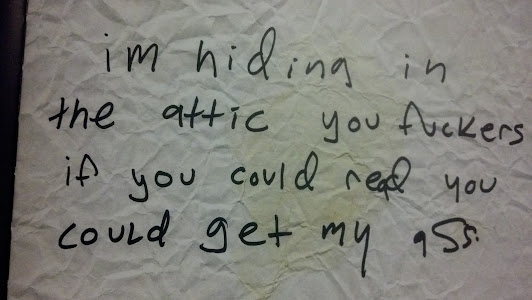
This is solidly a half-hour book, something you should put down fast with a bullet in its brain before it turns. These sort of found-objects collage things rely on you, the reader, to fill in gaps and create narrative, the way the social animal in us does, and I can entirely see being in the wrong mood for this, thinking too hard about specific instances, and generally having this frame narrative not hold together. But I really enjoyed the whole existential Marco Polo that went on, people scrawling notes to one another as the end of the world went down. My favorite in the collection is this:

I'm hiding in the attic you fuckers if you could read this you could get my ass

The worst thing about zombies is that they are illiterate, my friends. Boo yah.