On the Beach: 9½ Apocalypses

I recently discovered that all of the posts I wrote for the late, lamented B&N Science Fiction and Fantasy blog have been taken down. I’m going to repost the ones I think worth reposting. This roundup was written in April of 2018, and it’s one of my favorites. What a weird idea for a listicle.

Though I’ve never lived near the ocean, I’ve had a long and personal relationship with the rocky shores of Lake Superior. Though it may not have tides, as North America’s largest body of fresh water, it has the moods and rages of an ocean: playful and quiet one day, murderous the next. My grandparents’ small beach on old Highway 61 (the same one immortalized in the Dylan song) would look entirely the same for seasons, until a brutal storm blew through, picking up a tonnage of rock and tossing it as easily as giants playing catch. The beach was the end of things, both immutable and changing at once, a punctuated equilibrium of geologic forces working themselves out on a day-to-day basis.

In the end, the changing constancy of the hard line between land and water makes a lovely metaphor for the end. Of everything. On the screen and on the page, it’s surprising to think of how many creators end their apocalypses on a beach. Here are nine (and possibly 10) novels that find themselves on the beach at the finale, starting from or working towards that rough edge.

On the Beach, by Nevil Shute
On the Beach takes place in Melbourne, the southernmost major city in Australia, maybe nine months after the Northern Hemisphere annihilated itself in a nuclear war. The deadly radiation has heretofore been kept north of the equator, but the seasonal weather patterns will change soon, dropping death like a curtain onto all of humanity huddled on the southern edge of things. The tone of this novel is strangely quiet. Various people maintain through serious delusion—a young wife with an infant, who worries over a garden that she will never see bloom; a British Navy man who persists in imagining his family alive in England—but no one much bothers them about it. Some drink; some farm; some hold to a chain of command. There’s a gentle humaneness to humanity’s last interactions, in sharp contrast with many other novels on this list.

Which is why it’s strange I found it so difficult to read: the commonplace feel of the interactions makes Schute’s end of it all feel that much more real, that much closer to my everyday, even at a 70-year remove. (One of the reasons even much older end times fictions feel timely is the stripped down technology.) When my mother was in college, during the Cuban Missile Crisis, scant years after On the Beach was published, students hung a banner that read “I’m all right, Jack,” which were words displayed on one of the beaches in this novel—a last testimony of a near-dead humanity, a nuclear age “Kilroy was here.” Oof.

Cat’s Cradle, by Kurt Vonnegut
I read most of Vonnegut in one year-long binge, so it all tends to run together in my mind. Even so, Cat’s Cradle stands out. The plot (insofar as there is one) follows the three children of Felix Hoenikker, a fictional member of the Manhattan Project, which developed the atomic bomb. In addition to shepherding in the atomic age, Hoenikker also, in his free time, engineered a scientific lark called ice-nine, a seed crystal that can convert water at room temperature to ice. The martial and apocalyptic applications of such a thing become obvious with just a moment of thought; consider dropping ice-nine in Lake Superior, or, heaven forbid, the ocean. Vonnegut’s style tends to something both funnier and bleaker than gallows humor: something like satire, but more surreal. It ends, as the world ends, on a beach, with our hapless narrator meeting up with the founder of an ironic religion and unironic Hoosiers both. Though not as explicitly anti-war as Slaughterhouse-Five, Cat’s Cradle nonetheless deals in the horrors of the arms race and technology’s inevitable devastation, right there on the edge.

Wittgenstein’s Mistress, by David Markson
While David Markson is better known as a post-modernist and philosophical writer—the title Wittgenstein’s Mistress being something of a post-modern joke, insofar as that’s a thing—this is explicitly a post-apocalyptic tale. The possibly unnamed narrator (maybe it’s Kate, but who’s to say) types Twitter-length paragraphs into a typewriter at intermittent moments. She’s living on a beach, in a beach house, in a world where all animal life, save for herself, is dead. It’s hard to say how long this has been so; long enough at least for her to circumnavigate the world, go mad, and come back to herself enough to write into the void. If you have a better background in philosophy than I (there’s a lovely introduction in some editions by David Foster Wallace, who has just that) you could find more intellectual delights in this book. Myself, I found it achingly lonely and weirdly prescient, a pseudonymous writer shouting into a faceless and possibly nonexistent void (if that’s not too much of a paradox). Who was your last follower on Twitter? Are they even real? Are you?

(Sidebar: Speaking of DFW, it’s possible Infinite Jest should be included in this list. The last line of Markson’s novel—“Someone is living on this beach”—stands as counterpoint to Wallace’s in Infinite Jest—“And when he came back to, he was flat on his back on the beach in the freezing sand, and it was raining out of a low sky, and the tide was way out.” Wallace’s novel is arguably science fictional, existing in a satirical late-capitalist corporatocracy. The nominal plot involves a video that cannot be looked away from once viewed; a lethally addictive media. You can argue amongst yourselves about the levels of post-modernism and apocalypse in these novels; what fun! Either way, be it apocalypse or not, Infinite Jest ends on that contemplative shore, watching the tides.)

The Wild Shore, by Kim Stanley Robinson
The Wild Shore is Kim Stanley Robinson’s first published novel. It is also the first in a trilogy that imagine possible futures of Orange County, California. (In this, the trilogy is like Ursula K. Le Guin’s Always Coming Home, about a people who “might be going to have lived a long, long time from now in Northern California.” I’ve always liked that complex future tense.) The Wild Shore takes place a half a century after the United States was mostly obliterated due to widespread nuclear detonations of unknown origins. The community of San Onofre is largely pastoral, though through the tutelage of local history-keeper Tom Barnard, its denizens understand something of what the country has lost. When they begin to treat with the more worldly city of San Diego, the real bildungsroman begins, following young Henry (and his fellow citizens) into childhood’s end, both societally and personally. Nobody much writes post-apocalyptic pastorals anymore, but The Wild Shore stands on a strange pivot between that lapsed genre and the later, bleaker version of ash and despair. It’s fitting that Robinson’s first novel starts on a shore, as he, more than any other science fiction writer around, is the writer of beaches: from the final, thrilling moments tumbling in the water at the end of Aurora, to the drowned city of New York 2140, his novels tend to seek out that liminal space.

Oryx and Crake, by Margaret Atwood
Oryx & Crake opens with the self-named Snowman, on a beach, surrounded by child-like primitive humans he calls Crakers. Humanity has been wiped out, replaced by these simple beings. As he hikes inland to the ruined corporate compound RejoovenEsence to forage for supplies, he meditates on how the world came to this state: peopled mostly by antediluvian innocents, except for a few, dirty scavengers who remember the world as it was, as our world, one of technology and literature. The novel moves from the beach inland, which is a notable reversal. Atwood sketches a pastoral that is anything but desirable, and walks the reader back through time to uncover how such a dubious utopia came to be. Leave it to Atwood to rip the pastoral form to pieces; the simple life is not simple at all.

The Pesthouse, by Jim Crace
The Pesthouse occupies a ruined America, half a millennia or more from when pestilence and geological and geological cataclysm toppled our technological society, and follows Margaret and Franklin through the shattered landscape, on their quest eastward to find the ocean, and there, to board a ship to some magically perfect Europe. It is in many ways the reversal of the typical American pioneer story, which heads westward to the promise of open land and new beginnings. (Which is not to say that, historically speaking, the land was either open nor the beginnings new, but this is the American Dream we’re talking about; Margaret and Franklin’s  apocalyptic quest is just as illusory.) They end on the shore after myriad trials, and there must make the choice to continue on to Solla Sollew, or turn back westward to the heart of America. As an American reader, I occasionally bridled at Crace’s use of dialect—that is not how we sound —but there are plenty of observations of the American temperament that simply could not be made by an American (Crace is British), and that I found fascinating. The beach in this one is a mirage, just there over the next hill, where all our American dreams can come true.

The Road, by Cormac McCarthy
We are introduced to the unnamed boy and father on The Road, heading toward the ocean. They’ve been living in a cabin in the wasteland the world has become; all life, down to the bacterial, appears to be dead. Their journey is a grotesque picaresque punctuated by all manner of horrors, but the dream of the sea and its redemption are forefront. The boy and his father are “the good guys.” But when they reach the sea, it’s just as dead as everything else, a slopping soup of iodine and salt. While the beach isn’t the place of salvation the two expect, it still gives the boy his next transition—maybe not precisely from boy to man, but something close and intimate, not unlike an adoption. “In the deep glens where they lived all things were older than man and they hummed of mystery,” McCarthy writes in the final lines. The image of trout in the water is a form of metonymy for the human spirit—cool and deep and hidden, less mercurial than the ocean, but just as vast.

The Forest of Hands and Teeth, by Carrie Ryan
This novel opens generations after the zombie apocalypse, in a society penned in by both the hungry dead and a rigid societal structure. It follows self-involved teen Mary on her bildungsroman, starting with her unlucky placement in her fenced society and traveling out into the wider world after the fences are breached. Mary is an intensely unlikeable protagonist, well more focused on finding the mythical ocean than on the well-being of anyone around her. She learned of the ocean from her mother, who told her fairy tales of water so vast you could never see the end. The one she finds isn’t anything she expected—less a dream than another place strewn with the dead. Her final moments on the beach have a stark, downbeat beauty, even while they lay waste to her childish dream.

The Space Between the Stars, by Anne Corlett
At the opening of The Space Between the Stars, we find Jamie Allenby shivering out the last fevers of a lethal plague that has annihilated 99.9 percent and then some of a human race far flung over dozens of inhabited planets. Jamie sets out on a journey through empty worlds,  attempting to get home to the Northumbrian coast of England, where she hopes her estranged lover still lives. The image of seaglass, tumbled smooth through the action of water and tides, wends its way through the novel, a metaphor for the grinding action of trauma and recovery on our protagonists, and everyone else left. The novel ends quite literally on a beach, alongside people quietly rock-picking their way through the end—and then on to a tentative beginning, putting together the broken pieces of the world.
Review: Wild Sign by Patricia Briggs

I have a definite thing with the paranormal concept of “mating”, which is mostly understood to be an unbreakable romantic bond that exists independent of the emotional state of love. Obviously, romance novels have certain parameters to them, namely, that there be an HEA or HFN, so mostly they don’t address the glaring problem that a bond like this, one independent of emotion, can represent. So I kind of freak out when writers address the potential disconnect between mated bond and honest affection, because it’s so vanishingly rare. The newest Alpha & Omega novel, Wild Sign by Patricia Briggs, addresses this issue. The only other novel that I can think of that takes on a disconnect between mated bonding and real affection was one of Elizabeth Hunter’s Irin Chronicles, The Secret. That instance was utterly heartbreaking.

I have a pet theory that the “mating bond” acts as a sort of safety net for people writing overbearing asshole types, which many of these shifters tend to be. The whole pack hierarchy of dominance/submission, which is de rigueur in shifter narratives, offers up a steady supply of pushy, domineering alpha males (literally! har har) whose behavior towards women would be legitimately alarming in real world contexts. (Hell, often their behavior towards other men as well.) With the introduction of the mating bond, that more or less ensures the romantic lead won’t go fully physically abusive, though of course the more intangible methods of abusing and controlling one’s partner are still fully on the table. Admittedly, the Alpha & Omega series isn’t quite a romance series, though it includes a strong romantic through-line, so much of my noodling about the mating bond doesn’t apply, exactly.

The Alpha & Omega books follow the married couple and mated werewolf pair, Anna and Charles Cornick, the Omega and Alpha of the series name, respectively. The werewolves in this universe are often incredibly violent, and the pack bonds are just the thinnest check on that violence. This is in direct contrast with shifters like the Changelings in the Psy-Changeling series by Nalini Singh, whose shifter nature instills a sense of protectiveness and community. Singh’s Changelings are almost constitutionally incapable of abuse; Briggs’s werewolves are all too capable of violent outbreaks, and in some cases predisposed. Further, Charles acts as his father, Bran Cornick’s enforcer, and Bran is the pack leader of all North American werewolf packs, a sort of uber-alpha. His direct pack is made up of the hurt, damaged, unstable, and otherwise not housebroken werewolves. As his dad’s strong arm, violence is literally Charles’s job. His bond with Anna provides ballast for him, a line out to softer, kinder human emotion.

But the mating bond between Anna and Charles — one that seems genuinely enviable — is not the relationship at issue in Wild Sign: it’s the prickly, disconnected connection between Bran Cornick and his mate, Leah. The fact that they are mated but seem to have a deep antipathy for one another has been a thing not just in the Alpha & Omega series, but the Mercy Thompson books as well, where Leah acted as mean step-mom antagonist. Frankly, the way the antagonism between Mercy and Leah was introduced and maintained was indicative of a problem Briggs had writing relationships between women, at the very least in the earlier novels in that series, but really going up to the one that took place in Europe? I find the individual novel names forgettable. Anna’s relationship with Leah has been less antagonistic, but largely Leah is portrayed as a harpy Bran ruefully puts up with. And honestly, if I were Leah, I would be less than impressed with Bran’s lackluster care and concern. His treatment of her as an irritant has never sat well with me.

Wild Sign acts as a corrective to this, and gives us not just Leah’s backstory, but also the origin story for her relationship with Bran Cornick. Anna and Charles head out to the California wilderness to investigate an off-the-grid town full of magical users which seems to have vanished without a trace. Apparently, this town was on land that Leah owns, and both the land and the reason for the town’s disappearance are connected to her mating bond with Bran. Suffice it to say, there’s some real nasty shit in her backstory, the kind of thing even Briggs addresses mostly euphemistically. Her bond with Bran is anything but ideal, almost an echo of said nasty shit, and it’s completely legible why they would hold each other at a distance. They are bonded by trauma, unbreakably so, but trauma isn’t actually ennobling, and intimate violations can play havoc with one’s ability to be intimate.

It’s a lot, and there were certainly points where I wondered if maybe it was too much. But then Briggs has never much shied from really nasty traumas, especially in Alpha & Omega. Charles and Anna met, after all, when he had to execute her pack leader because of the alpha’s brutal sexual, physical, and psychological abuse of Anna and others. And indeed, the antagonist in Wild Sign dredges up this history of violence for Anna — makes her relive it — in a way that felt true to the ways trauma can resurface, even for people who are functionally healed. Shifter narratives, especially those that center on werewolves, deal often with body trauma, I find, something having to do with the werewolf’s lack of control over their body, and the violence of the physical change.

That said, there are some real moments of levity in Wild Sign, like Anna and Charles’s run in with some sasquatch, or the basis for the monster of the week the novel has going. Which is good, because darkness pushes on everything they do, threatening to snuff out the sometimes tremulous light. It’ll be interesting to see what comes next.

All Politics is Feudal: This Dark Earth

So, I was recently watching The Dark Knight Rises, and laughing to myself about what a brilliant expression of post-9/11 fascism it is. I don’t mean the term “fascist” in its sloppy usage of “stuff I don’t like” or “dad”, but the more old school definition of authoritarian militarism that positions the arbiter of justice not in law, but in an idealized übermench, you know, with your usual racial and nationalistic overlay on what makes the mench über. Bad guy Bane talks a lot of shit about giving power back to the People — invoking the dialectical enemy of fascism, communism — but as a fascist tract, there is literally one person who might be considered “the people” with a speaking part, and that’s Catwoman’s wing-girl. She has maybe three lines. The police state and the über-police state are pretty much the only important players in a city of 11 million, the People existing either to cheer Batman or drag rich people from their homes dumbly. It’s pretty much a Leni Riefenstahl film, both in terms of ideology, and stunningly beautiful fascist aesthetics.
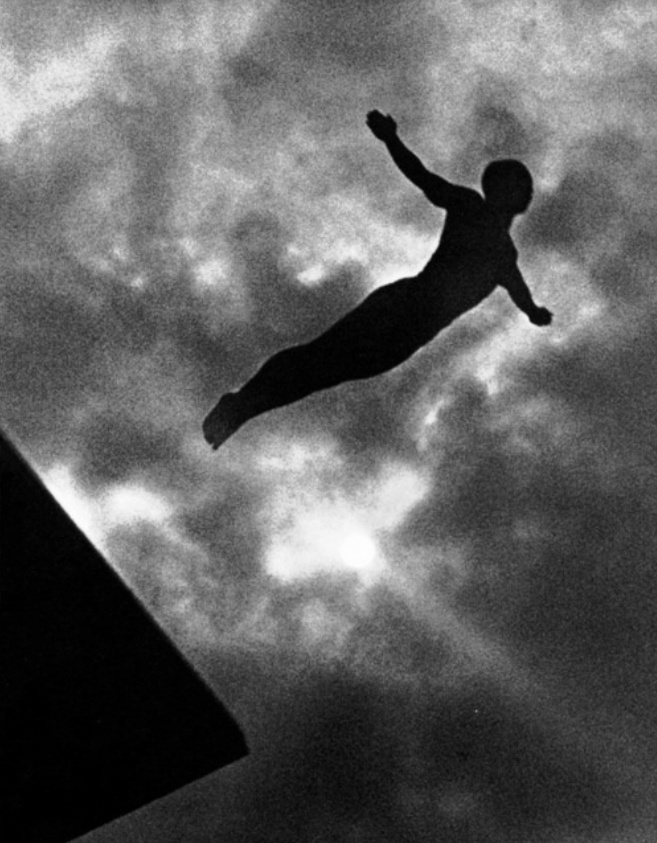
A black and white photo of a black figure in a diving pose against a background of moody clouds

A diver in the 1936 Olympics, photographed by Riefenstahl

Putting aside some lumpy plotting — which no doubt was caused by Heath Ledger’s untimely death after so perfectly capturing hysterical nihilism in The Dark Knight (and I’m glad they didn’t re-cast the Joker) — The Dark Knight Rises brilliantly expresses the not-so-latent fascism of the superhero story. It’ll be interesting to see what the Nolanizing of Superman comes up with in Man of Steel, because Superman was your granddaddy’s very first anti-fascist American fascist superhero. (Sometimes you gotta fight fascism with fascism, apparently.) Somehow I don’t think it’ll work, because Superman is boring, and the best fascists have some chutzpah. The old fanboy saw is that Kent is the disguise, and overpowered aliens posing as dorks are hard to put the banners up for. Squeeze out that single tear, fascists, then we’ll root for you.

Anyway, some what belabored point being that I was reading This Dark Earth at the same time, and kinda musing to myself about all the post-9/11, fear state, how-will-we-maintain-our-humanity-in-the-face-of-terror that I see as endemic to the zombie narrative. This Lord of the Flies with cannibal corpses has been going on at the very least since 9/11, but certainly bubbling there in Romero’s game-changer, Night of the Living Dead, where he rips the shit out of the American nuclear family and societal structures, and probably even earlier in your older school Voodoo sorcerer controlling reanimated slaves folklore. (Sophomore level paper topic: taking the farmhouse in Night of the Living Dead as a structure that symbolizes the Freudian psychological model — id as basement, ego as main floor, superego as attic — map the movement of the characters within this landscape as pertains to societal construction. Et cetera.)
So, This Dark Earth is, in some ways, a very traditional zombie story, starting in a hospital becoming overrun as the doctor very slowly accepts what is occurring around her, complete with zombie infants and a chemical dump outside of town. A basement-bound reunion of mother and child, a bullet in the brain of a turned husband, a military group using a woman as rape fodder and mama, a barbed wire settlement slipping towards feudalism, a girl writing notes that she’s sure no one will read — it’s all there, and more — the wrangling and hand-wringing of the boy grown into a world with new rules, the prince of this new dark earth. The steam train. The slavers. Jacobs hits all of this, lightly, humanely, with an eye toward the individual that I feel gets lost in a lot of zombie stories, somewhat perversely. Even with very large time shifts, the pacing is furious while still managing a tightly personal tone.

A lot of people are going to invoke AMC’s The Walking Dead with this book — and I guess I am too — but this book checks a lot of the stupid societal bullshit of that show: Rick shouting about how “this isn’t a democracy” and then getting his ass bitten by eye-patched demagogues (but not literally, of course), Carl turning into a squint-eyed tiny badass, the rheumy moral mouthpiece wondering “but at what cost?” I’m still into Walking Dead for the set-pieces, because those continue to thrill, but I have no patience for the people or the society of that show. And I’ve lost patience with the characters of The Walking Dead because it never comes out and owns the inherent fascism of the zombie survivor community, not with any finesse anyway. Breathers are all imbued with exceptionalism in the zombie apocalypse. It’s numbers; that’s all. But on The Walking Dead, Rick gets to be touched with the invisible hand of narrative superiority/safety, lending his leadership a sort of unassailable divinity that should just suck it. This Dark Earth addresses that impulse to feudalism, and it does so while being beautiful in an unshowy way.

I almost don’t want to recommend it to your average non-horror reader, because I think what Jacobs is doing is subtle, this slow, personal invocation of all the tropes of the genre, that sets them all up and knocks them all down, slowly, like a steam boiler, like cancer. Death is the greatest democracy there is; we all have our one vote. Survivalist groups in the zombie apocalypse are often pictured as Spartan paramilitary camps set against the undead Athenian mob. I think that we tend to conceptualized survival this way shows our instinct towards feudalism — the dictatorial Governor in The Walking Dead growling about terrorists, the slaver in This Dark Earth looking for a king to behead. Both Carl and the “Prince” here are positioned as the members of the New World Order, unable to remember the world before the mob, groomed in violent expediency to threats both real and imagined. I’m not sure where The Walking Dead is going to go with Carl, but I have my suspicions, and I’m already girding my loins for disingenuous speeches about honor and stuff.

this is not a democracy anymore, it's a ricktatorship with an image of Rick Grimes from Walking Dead

Observe Jacobs, instead:

The world loves a tomato because it’s red. The apple is red too. But the tomato’s flesh is the flesh of mankind.

Do the dead love the flesh of man because it is like a tomato? We’ll never know. But I have my suspicions.

As the matriculating Prince observes as he filches tomatoes from their tenuous garden. There are times when this is too much, like in an overtly symbolic sequence that has our boy crucified, quite literally, on an exit ramp sign, but then Southern Gothic (which this book is also, in many ways) often can’t help its dips into histrionic religious imagery. Jacobs runs this linear and time-skipping narrative hand-over-hand, from one point of view character to the next, which I believe works beautifully with the stakes and danger of the undead-filled world: you will hear this voice, but you will not know when this voice will end, or if it will pick up again on the edges of another person’s story. Knock-out’s sequence, and the boys on the steam train were especially tight. (And I have another sophomore paper topic ruminating about the train as it fits into the American landscape as some kind of echo of industrialism and colonial expansion, but I haven’t worked out all the kinks.) Certainly, This Dark Earth isn’t reinventing the wheel in terms of zombie narratives, but I thought it dealt with the tropes in a thoughtful manner, which for me can be much more enjoyable than genre-confounding gimmicks or the like. I, for one, welcome our zombie apocalypse feudal overlords, at least as described by John Hornor Jacobs. Hail to the king, baby.

Love & Zombies by Eric Shapiro

Love & Zombies by Eric Shapiro is one of those things I haven’t known what to say about because experience isn’t reflection. I enjoyed reading it, but I’m not sure I can say anything smart about it. I blew through a bunch of novellas all in row, which made me have a whole thing about what makes a good novella versus a novel or a short story, but then I waited too long to write any of those thoughts down. But let’s see if I can recreate some of it. 

First off, the novella is a funny beast, occupying an odd middle distance. Novellas can fail in a lot of ways: not concise enough, meaning they should have been cut to a short story, or taking on too much, meaning they should be a novel. (And the latter might not actually be true, because some of my most hated books were expanded from short stories and/or novellas.) I feel like this book fell into the latter category, in that there was a lot going on, but expanding this scenario would only weaken it, while the specific aims of the story needed a little more time. The most successful novellas I’ve read often occur in already established worlds, so the exposition is just gestural, and then we can go from there. It was the exposition stuff that didn’t work so great for me here, so. 

Love & Zombies starts with a very satisfying first person voice: self-effacing while self-aggrandizing, and just freaking funny. The way he introduces you to the other characters – a girlfriend, an asshole best friend – was really grand, with a lapping, anecdotal quality I enjoyed. Turns out the asshole friend wants to pull some ill-conceived and unethical job for a cuss-ton of money, and our protagonist goes along with it for pretty stupid and illogical reasons. Which was okay by me, because I’ve certainly done stupid things for stupid friends, and I’ve probably stupidly entreated friends to do stupid things for me, and sometimes they’ve even gone along with it. Childhood friends especially, because even though we were just friends because of proximity, when you think about it, nostalgia plays its ugly hand.

The set up is very pulpy, and therefore pretty bananas. Main character dude is feeling emasculated because his hot girlfriend is possibly too GGG, and he’s not feeling worthy of her. This kind of amazing perfect gf for an admitted loser could piss me off, but our MC actually acknowledges that his feeling are dumb, and doesn’t put his crap on her. The stupid, unethical thing in this case is to drive out into the Nevada desert from California, find a zombie, and then squire her to Las Vegas, which is where everything, in pulp style, goes even more pear-shaped. 

Oh, did I mention there were zombies? This being one of the things that didn’t work so great for me in this novella. Apparently there have been zombie outbreaks all over the flyover states, but places like southern California have heretofore been untouched by the zombie plague. Which, fine; maybe my irritation with this set up is that I live in a flyover state full of zombies, so this sort of coastal insouciance about the zombie plague reads a little lame. I think it works in the whole personal metaphors of the main character, so it’s fine, but it doesn’t work on a nuts-and-bolts nerd world-building level. I guess I’m just saying that the world doesn’t make any sense, except as a personal metaphor, which is why this both works and doesn’t as a novella. You can’t expand it, but you can’t contract it either. 

I’ll just say: I liked the voice on this thing a lot. The main character is right: I may not like him, but I love his girlfriend, or maybe I just like how he talks about his girlfriend. (Which is another thing: as much as he talks about the girlfriend, I didn’t feel like I got enough screen-time from her to really dig her, except as a construct of the protagonist. Which is also fine, on some levels, because it’s about him thinking about her and not her. Just, it would have been nice to get a third act snap where you see what he says about her from a slightly different vantage, which would be her vantage. First person though, whatever.) 

I liked the near-zombie girl and the throats she rips out half-pretending to zombification. I also liked a lot of choices made by the protagonist, because while nostalgia may be sweet, his friend was a huge asshole. I’m not enamored of the tie-up, which read too cutesy perfect for me. Maybe the average novella should end with blood on the floor, because we don’t have the investment in your usual novelistic HEA. Maybe. It’s possible I’m bloodthirsty in my needs. 

Two of the novellas I read in my novella week were DarkFuse titles: this and Worm by Tim Curran. Worm was decidedly more about gross pulp thrills, while this was more voice-driven, with a chatting, hipster douchebag protagonist and his admittedly stupid problems. You could almost smoosh them up into a single hot novel, something with killer voice and killer kills. I kind of did that by reading them back to back, which I would recommend. The nice thing about novellas is you can put them down in a sitting, much like a zombie. Love, however, takes more than a headshot to vanquish. A worthy take-home, all told. 

Thank you,NetGalley, for the ARC. 

Steampunk! An Anthology of Fantastically Rich and Strange Stories

Steampunk! An Anthology of Fantastically Rich and Strange Storiesis a cromulent collection of short stories, though uneven like most (maybe all) multi-author collections. I do appreciate the emphasis by editor Kelly Link on steampunk stories outside of the now-iconic Victorian London steampunk setting. I like the thickly urban setting – it’s what drew me to the sub-genre in the first place – but I can get fiercely irritated with the way some steampunk fetishizes the upper class twit of the year with his goggles and laboratory that I sometimes find in that setting. So, to the individual stories.

“Some Unfortunate Future Day” by Cassandra Clare: Inoffensive piece of atmosphere that fails to say anything at all, cutting out right when the real narrative choices need to be made. The daughter of a mad scientist is abandoned by her father to go fight in some ill-defined war, leaving her in the care of Romantic talking dolls in a crumbling Gothic house. A soldier falls out of the sky, which leads to a lot of naive narrative imaginings from the girl, and then the obvious use of a Chekhovian timepiece and then…the end! It’s like a chapter cut out of a larger narrative where all the implications come to fruition in the next chapter. But the story is pretty enough, I guess, and the only thing I really hated was the entirety of Shakespeare’s Sonnet 64 used as an epigraph. Seriously, who does that for a short story? Ugh. 

“The Last Ride of the Glory Girls” by Libba Bray. I would absolutely kill for a Glory Girls novel, which is not to say this doesn’t function as a short story. Reminded me strongly of Firefly, with its frontier planet full of harsh religion and frontier cruelties, written in a stylized dialect that totally works. Pinkertons, train heists, girl bandits, divided loyalties: all the things that make Old West stories a hand-to-hand combat of colonialism. There is also arresting baptism by sludge sequence here, a very tactile metaphor for the industrial revolution, etc etc. 

“Clockwork Fagin” by Cory Doctorow. Very anecdotal story, told in the first person by a boy matriculating in an orphanage of children mangled in punk-shifted industrial factories. “Clockwork Fagin” is obviously a Dickens riff – Fagin was the antagonist in Oliver Twist – with its social consciousness and the plight of youngsters in the industrial machine. Full marks for being a story that doesn’t fetishize the corsets and monocles set, instead focusing on the organized rebellion of the working class. Workers of the world, unite! 

“Seven Days Beset by Demons” by Shawn Cheng. Seven deadly sins in comic form with perplexing steampunk ornament and terrible lettering. At least it’s short. 

“Hand in Glove” by Ysabeau S. Wilce. Too smart for her own good detective gets on the trail of a serial killer, despite an indigent man having already been convicted to hang for the murders. Some of the plot mechanics were unsuccessful – I didn’t like the mad scientists much – but the narrative voice is snappy, and the overall aims of the story worthy. The ways entrenched bureaucracies, like the police force, use and abuse science are always worth examining. 

“Ghost of Cwmlech Manor” by Delia Sherman. Not really to my taste, but a goodhearted little story. Cwmlech Manor is haunted by the ghost of the once mistress of the manor, killed in the English Civil War by Cavaliers looking for loot. The main character is a plucky girl type, who is pragmatic about her romanticism. 

Best of all, I loved the story that went with [Cwmlech Manor] – very romantic and a girl as the hero – a rare enough thing in romantic tales, where the young girls always act like ninnies and end up dead of a broken heart, often as not.

You can see the grammar is tortured, but the sentiment is neat. Her remark about the legend ends up describing her own story. Go girls. 

“Gethsemane” by Elizabeth Knox. A perplexing story, one with interesting themes that never came together satisfactorily for me. The setting on a Caribbean island (?) was cool, as were the racial themes: passing, folklore, even the old school non-Romerian zombie. But the plot ranged over too many characters, and shifted perspectives weirdly. I admit I just didn’t get it, but I suspect there was something here to get. 

“The Summer People” by Kelly Link. Editor, edit thyself! Which is a bitchy thing to say, and I don’t really mean it. This isn’t a bad story at all, but its steampunk elements are so nominal as to make it feel like a shoehorn job in the collection. It’s not even so much that I don’t think magic has a place in steampunkery – there’s a growing body of dash-punk work out there that shifts history by magic instead of technology – but that this magic doesn’t really do that. That said, I enjoyed this story about a girl tasked with minding the summer people, who we first are to understand are summer vacationers to her poor, rural setting. I liked her relationship with a vacationer-turned-resident, a girl who is slightly enamored of all the folksy poverty, which is of course only folksy to outsiders. The ending is a bit obvious, and the denouement more truncated than I would like, but a good story anyway. Fine, Kelly, you win. 

“Peace in Our Time” by Garth Nix. I’m on record as a Nix fan, but the more I see of his short fiction, the more I think he shouldn’t write it. The narrative voice was daft and grated, and the characterization poor. It wasn’t so much a story as a situation, one that ended in a OH DO YOU SEE? reveal that hearkened to the hokiest of Twilight Zone endings. Bah. 

“Nowhere Fast” by Christopher Rowe. Another short story that ends right before it should get interesting, where the real conflicts are going to begin. I don’t feel as irritated by this as the Clare short story, because at least this world is aiming for something more than pretty but useless. This is one of those post-apocalyptic utopias that no one bothers to write anymore – two generations past peak oil in a fiercely local America. A boy in a car, of all things, shows up in town, which kicks over a bunch of anthills. Given how bound up in our national identity the automobile is, it was interesting to consider the American landscape without them. 

“Finishing School” by Kathleen Jennings. Another comic. Slender reimagining of the invention of flight, this time by a daughter of Scottish and Chinese parents who is stuck in an Australian school for girls. Nice metaphors of girlish exuberance. When a friend’s mom got divorced, she took Amelia as a middle name. We long for flight sometimes, and sometimes we should get it. 

“Steam Girl” by Dylan Horrocks. I think I’m going to call this one out as the stand out of this collection. A nerdy, chubby boy semi-befriends a poor, outcast girl. She tells him stories of Steam Girl, an obvious self-avatar grown long-limbed and beautiful in her pulpy imaginings. Horrocks has a good sense of the teenage outcast – not the romantic one, with his bangs in his eyes, but the real kind: uncomfortable in his body, clueless, and slightly horndoggish, but not in a particularly nasty or cruel way. Escapism is important for people who have something to escape from, and this story is so sensitive to that equation. 

“Everything Amiable and Obliging” by Holly Black. Fine, I guess, but I don’t think all the implications of the central metaphors here were considered, so I feel all squicky in the end. A girl falls in love with a house automaton, and her family tries to dissuade her from her love of the dancing instructor robot. He’s part of the hive consciousness of the house, and there’s a lot of shouting and stuff about loving robots designed to give you exactly what you want. That’s not the squick part for me. The squick part was when this was equated with the other girl’s lack of agency in her own relationships, and then my brain started shouting, but wait! Are we characterizing the working class as automata? Are we really saying girls lack agency? I can see where Black was going with this, I just don’t think it was thought out enough. 

“The Oracle Engine” by M. T. Anderson. A Roman steampunk story. And not modern Roman, but the Classical kind. Holy shit, but this was fun. Written in that gossipy historian’s voice, the one that relates a bunch of folklore and quotes the classics, and then pulls back demurely and says there isn’t any basis for that conjecture. I was fully expecting a Mechanical Turk at the center of this story, which, if you are not familiar with the concept, was a chess-playing engine invented in the 18th C, but turned out to be a dude hiding in a box and not an automaton at all. (Amazon has named it’s crowd-sourcing venture after this, and this enterprise is why capchas have gotten so freaking annoying.) That would have been neat, but the actual center of the story is so much cooler and weirder. GIGO. 

Oh, and also? The scientific ornament was brilliant. Archimedes almost invented calculus, for crissakes, and while there’s no guarantees that the lunatics of the Middle Ages wouldn’t have lost his discoveries – like they did with how to make concrete – had Archimedes’s discoveries become widely known, it is a fun thought experiment to consider.

Exit Kingdom by Alden Bell

Even though I knew full well that a sequel to The Reapers Are the Angels was bound and determined to disappoint a mite, I freaked out anyway and ordered a copy from England. America, why you no publish Exit Kingdom? I fairly loved Reapers, with its blurry genre lines and metaphysical America, a long toothpick poling the detritus in our bloody civic teeth. I can see why some readers wouldn’t cotton to it: the heavy allusiveness and almost overt symbolism, the dialect, the stripped punctuation, the zombies. But I loved Temple. I loved her fierce orphan pragmatism, a child of the apocalypse more easy with wastelands and the dead than nail-bitten civilization and the living. She was all squinting prairie hardness and kudzu tenacity. 

Exit Kingdomis less sequel and more companion novel, a recounting by Moses Todd five years after the events in Reapers of five years before the same. Moses Todd may have been an anchor to the events of Reapers, but he was not the center, and his centrality here is uneasy and reactive. There’s another girl, the Vestal Amata, whose central mystery did not resonate with me, whose femininity and changeability seemed the kind of thing a man would understand about a woman’s nature, but no woman would ever feel inside herself, about herself. That’s fine, on some level: this is a man’s story of a woman, and not her own. People are told in many ways. 

Moses and Abraham Todd are moving aimlessly through the American wasteland. Abraham isn’t right, a predatory monster, and Moses with his unspoken code plays brother’s keeper. They are given charge of a woman, the Vestal Amata, who has a strange thrall on the unquiet dead. The dead are blind to her and her movements. Though there is no section like the hillfolk sequence in Reapers that I actively disliked, the conflicts and personalities here felt more forced throughout, more schematic. The landscape, and especially the dead themselves, that I found even more strong than in the previous novel: Moses’s hands on the bellies of airplanes in a rusting hangar; the eyes of a dead man slowly blinking under ice; the dry bones trying to stand in the desert aridity. 

So, if you enjoyed The Reapers Are the Angels, you will likely enjoy this, but in a worn way, in a way that tries to recapture a dream slipped out like a fish. Now that I write that, I remember with a painful clarity the nightmares I had from this book last night – a nightmare far out of scale from the near placid and resigned tone of this book. There were children – a school room – and so much blood from biting as the infection spread from child to child. Today’s events in Connecticut – I cannot stop crying. I dream nightmares that come true. Oh, America, I fear and grieve for you so much. Moses Todd does too, and that part we can agree on.

The Hidden Goddess: Second Verse, Same as the First!

Second verse, same as the first! 

Just kidding. 

Sort of. 

I liked the first of this series, The Native Star by M.K. Hobson, almost despite myself. The opening is rough, like a chainsaw working out the bite into the flesh of the log. But it finds its bite partway through the book in a way that treats American history with respect, even though I wish a little more of that history made it into the book. Or, you know, in a way that mattered. 

Second verse, same as the first. By which I mean, this epilogue starts with some seriously interesting stuff about Grant’s presidency and alt-history stuff about the sources for the American Civil War, and then, and then, well, nevermind all that! I’m not really complaining, I guess, because Hobson took some things about the first book that I really sparkled on and expanded them – like the effects of gender on the credomancy explained in the first book – the magic of belief – in the character of Miss Jesczenka. I almost wanted her to chuck Emily – our heroine from the first book – and focus on the spectacular Miss Jesczenka, who articulates an astonishingly personal and accurate ambivalence about the experience of being a woman in a misogynist society. Just, good Lord, she’s so awesome. 

It’s not even so much that I’m bagging on Emily – she is a fine main character, with her fish-out-of-water folksy ways – but I felt like the inevitable second book issues between Emily and her paramour, Dreadnought (oh, just barf on the names here, even though they are explained better in this outing) fell into a lot of lameness traps. Emily and Dreadnought (ugh) spend a lot of the first book sniping at each other in that antipathy-is-attraction way, while here, they are kept apart by a bunch of logistics and the occasional bullshit misunderstanding. Some of the misunderstandings were valid – Emily’s search for her birth parents, and the varying allegiances and mis-allegiances found and lost by her questings were spot on – but sometimes it was like, ZOMG IMMA MISUNDERSTAND SOMETHING I JUST WALKED IN ON THAT IS EASILY MISCONSTRUED. Bah. 

Emily and Dreadnought’s (ugh) relationship is never anything more that paint-by-numbers – right down to the argument-ending kisses he plants on her more than once – which, I would like to know if that has ever actually worked for a dude irl. I’m not sure why the wisdom is that lovers have to be kept apart in book two, but I’ve see it often enough for it to be a thing. Shame, really, because there were a number of developments that I could easily imagine Dreadnought (ugh) and Emily tackling together, because the implications had more than enough potential for conflict between them to arise – real conflicts, rather that logistical bumbling and iffy misunderstandings. The baddie here is so over the top she’s maybe hard to take seriously, but certain political situations were neat enough to keep me from focusing on the unreality of the bad guy’s motivations. 

It’s been a while, but I felt like the tone of this book was more consistent, and more consistently goofy than the first, though I do not mean that as a dig. A failing of the first book might be that that it expected me to take some very silly stuff seriously, while here there’s some very serious stuff that might have been treated more lightly than it should have been. The question of tone is a tricky one, one that I don’t have an easy answers for, though I get the difficulties of managing a story that is equal parts end-of-the-world, banter-y romance, and alt-history. That the tone is managed as well as it is is certainly something. 

The ending dot dot dots to a certain kind of romantic completeness, which both irritates and satisfies in equal measures. I went to look for the next book in this series – that’s how on the hook I am – and it looks as though the narrative of Emily and her Dreadnought (ugh) will be skipped over to writhe in the stories of their kids. Which, boo a little bit. Given the end, I would like to hear some stuff about how Dreadnought (ugh) deals with…some things, how he copes with losing something fairly vital to his personality. Love is the answer and all, but, as the narrative here says, it’s just a start. Too bad that’s all we get here.

Review: The Road Goes Ever On in a Slightly Depressing Manner

I’m not sure there’s much I can say about The Road by Cormac McCarthy that hasn’t already been said, given that I’m the last person on earth to finally read this book. (Thankfully, I’m not the last person on earth.) I gave it a try two years ago, but got something like 10 pages in before I flipped out. I was still nursing a babe at the time, and the ash, the dread, the Child made me physically hurt. I am not being metaphorical. I’m alternately gobsmacked by and resentful of how masterfully McCarthy played this one: gobsmacked because lord, this man can write and resentful because I don’t like being played.

This reads like an inverted landscape picture. You know, the kind of film that is about sweeping aerial shots and slowly panning vistas, the ones where the human drama plays out in grand tension with the callous beauty of Nature and her almost casual marriage to that old Greek grumpus, Fate? Brokeback Mountain is a landscape picture, and it has a similar claustrophobic sense despite the unpeopled grandiosity of the titular mountain. Here we don’t have all the bleating savagery of nature as our landscape, but its opposite: a gray sun, everything still and inexplicably dead but not fecund in rottenness, even the microbes that inevitably break us down gone still and cold. The night that the man and his boy spend in a wood that succumbs to its fragility and falls down, crashing almost without an echo; the years-old apples hidden in the straw-like grass, still edible; the soft slosh of an iodine-scented sea stripped of its sea-like glory: these visions I found incredibly, page-turningly effective.

While I admit that much of this feels intentional, I found the relationship between the father and son seriously problematic. Maybe this is my own hang-up. I bitch not about the stripped down punctuation and the almost childish and-then-and-then of the description; this was something akin to poetry. However, the simplicity of the world-view espoused by the father: the bad guys and good guys, this rankled a bit. I find it…improbable that a boy raised in this kind of environment would be so trusting, so willing to part with precious resources. Something about the scene from the past where the clocks all stop at 1:27 and the man begins to fill the bath with water, not because he needs a bath, but because he knows, instinctively, that this is the end of the world makes me wonder. The way his wife spits out her tiredness with living, vanishing into the ash almost without comment, is this all in his mind? Is this world a sick vision he’s foisted upon his son? Does that make this vision better or worse?

A million years ago, when I went to Sunday school and read the bible, I was always puzzled by Cain’s going out into the world after the murder of his brother, his mark a brand to let others know of his crime. Where do these other people come from? Whither Seth’s wife? There’s something of that here. Cain and Abel’s story is the first landscape picture, the first small, intense family drama to play out in an empty world. For them, the emptiness was the glory of unrealized potential, potential rendered ironic by the pettiness of human suffering. Cain’s story ends in shame, the mark of God’s forgiveness doubling as hopelessness.

This zippers that story backwards and inside out: the world has gone hopeless, useless, the end of it all and not the beginning, but with a human love and potential that renders the landscape ironic. The child’s last prayers to God the Father, I’m not sure what to think about this. Is this hackneyed or brilliant? There’s a lot of fictions that I wished ended 20 minutes before they did, before the problematic epilogue or whatnot: “A.I. Artificial Intelligence”, Crime and Punishment, etc. With this, I’m not sure about where my squeamishness is coming from. Do I expect and find comfort in harder lessons, even while the hardness presses indentations in my psyche? Do I hope for hopelessness? Maybe. Depictions of the end of the world are funny things, personal, societal, drawing out our quiet, familial, almost religious expectations of the people around us and writing them large and burning. The Road draws this story in ash, and while I wish this affected me more, it didn’t, even while I bow to McCarthy’s considerable skill.

Bickering as Courting: The Native Star

This was another insomnia read, picked up in the dark hours when no one but me is awake. Pretty much with an insomnia read I’m just looking for readability, which is one of those terms that is probably not that helpful. Maybe I should go onto Karen’s Reader’s Advisory group and try to define this readable beast.

Tone: light to medium
Pace: fast
Setting: not contemporary, possibly with magic, aliens, gadgets or other neat ideas that are fun to watch play out
Romance: light
Narrator: inobtrusive

Admittedly, these are just my criteria, but this is my insomnia and I’m sticking to it.

The Native Star by M.K. Hobson, on the dust jacket, is likened to Jonathan Strange and Mr Norrell, which I think works insofar as they are both mild alt-histories with magic as the alternate part of history, but the tone and pacing are very, very different. I would not want to read anything with footnotes, as much fun as they are in Strange & Norrell, in the odd hours. And as much as I love Strange & Norrell , the pace is glaaaacial. (And not to be be bitch, I think Strange & Norrell is a better book, by whatever odd metric I have for judging writing and content, fwiw. Just not better in the middle of the night.)

But! The other thing I like about likening this to Strange & Norrell is that neither one is steampunk, a label I see applied to this one. Forsooth, arguing about genre is a losing business, but just because something is an alternate history set in the late 1800s, that isn’t enough to make it steampunk. Magic ain’t gadgets, and a certain kind of fetishized retro-technology porn is an inextricable part of the (sub)-genre. But! I’m willing to concede that this is in the odd dash-punk edge of alt-history. I noticed some similarities between the sanguimages from this book and the warlocks in Bitter Seeds – indeed, both are termed warlocks, a nice double entendre on their need for blood to perform magic, and their usefulness in wartime. Tregillis’s book also has magic and something like steampunk – though maybe it’s more gaspunk? Sorry, Ian, wherever you are. I don’t know how to class your book, or this.

It’s like there is a cluster of dash-punk genres – alternate histories that keep coding and recoding history with various magics and the magics of technologies, pushing the true history to reveal itself. Mike has noted that most alt-histories have alt-histories written within them, and Native Star is no different: here, it is a series of pulp novels that comment on the magic-working characters, which is not dissimilar to the pulp novels in Raising Stony Mayhall. I have said this a thousand times before, but I do not care about originality, so if it seems like my comparisons to other books are intended to cut this one down, that is not my intent. This is a genre exercise, whatever that genre may be, and the parameters of the world and characters are individual enough to put down any talk of being a poor copy. I mean, points for a giant oil-soaked killer raccoon alone, if novelty is your bag.

So far, this is the worst book report ever, me blathering about things only interesting to me. So, to the plot summary:

The Native Star starts with a small town witch, Emily, with money problems putting the whammy on the town babbitt, in an move that backfires into zombies and some irate townspeople. She ends up with a magical stone lodged in her hand – don’t ask – and then the story is off and tumbling in a post-Civil War Old West. Her compatriot through these tumbles is a man called Dreadnought Stanton, which is possibly the stupidest name ever, and I never did figure why Emily was the only character with a non-stupid name. The beginning rankled a bit, what with the silly names and the poor characterizations – yes, Emily is smart but uneducated; yes, Dreadnought (ugh) is a stuffed shirt patrician type, but with seeeekrits. But – and this so rarely seems to happen for me – the characterizations completely tighten up as the book progresses, the stock characters thawing into something resembling humans. The action is well-written, and the banter ranging from not-distracting to super fun. I was expecting certain inevitable twists that ended up being different enough from my expectations to be satisfying. I’ll just say: fuck yeah, hubris!

I even came to peace with the names, which end up being often Dickensian and sly. There’s a lot of really funny hat-tips in this book, like the bounty hunter with an Italian accent who seems to have walked off the set of a Spaghetti Western. I found this delightful, especially because it was underplayed. And – this is going to be huge tangent – but can someone please write on of these dash-punk action thrillers in the Reconstruction South? There seems to be a lot of fictions that center on the myth of the Old West in narrating our American discomfort with Manifest Destiny, the Civil War, and – you know – all that blood let to forge the melting pot in the first place. And how the culture wars still rage along lines set down at the time.

The bestest of these fictions, to me, is the HBO series Deadwood, but there’s plenty more stories in that well, from Eastwood’s Unforgiven to the sublime moody weirdness of Jim Jarmusch’s Dead Man. This book opens with magical carpetbaggers slitting the throats of conciliatory but angry Southern merchants, and, hot damn, I really wish there had been more of that, as much fun as the Old West stuff was. But the dash-punk genre seems to encode these anxieties into magic or gasmasks or whatever, so I guess I can’t expect them to take on the Reconstruction South, when pretty much no one wants to touch that live wire, genre or not. Hobson does take on Grant’s presidency and the war obliquely, in a way I haven’t completely teased out yet, so that is something. (And I’m shit for history, really, so it would be cool if someones like Eric or Matt read this and gave me a book report. I’ll totally mail this to you. Kthxbai.)

So. There are things I could bitch about (not excited about the Native characters) and things I could praise (excited by the proto-feminist characters), but what it comes down to is that this was the right book at the right time. And not just to sound like I’m faint-praising this book for being a pretty midnight tumble, I spent the day thinking about the characters and the alt-history, unknotting some later plot developments and choices. There’s a lot of smart and funny here in all of the relentless action. Hot damn, that’s something, insomnia or not.

A Book of Tongues and Cussing, My Favorite Kind.

There’s going to be some swearing in this essay. If you don’t like swearing, you will not like A Book of Tongues.  

This book was pitched to me as “gay Deadwood”. That’s not wrong – there is a bona fide San Francisco cocksucker here in the mix – literally! And like the book that inspired the rec for this book, the action takes place in the complicated mess that is the post Civil War Old West – the odd mix of ex-Confederate soldiers and Pinkertons, Mexicans and Native Americans, slugging it out in the harsh Southwestern terrain and the shitty main streets that play at civility on the edge of this thing and that. And this thing and that aren’t that well defined anyway, so each place is a hinge to another place that’s a hinge. Hot damn. 

And like Deadwood, the style here is absolutely killer, written in its own vernacular that’s somewhere between cliché and profanity, tactile and personal. Files is an author to watch – she’s got words that are strong as hell, a style with force and power. But, and I hate to say this, as a first novel, there are some serious lapses in pacing and exposition. After a pretty boring opening, punctuated by impossibly complex Aztec backstory, the central section ramps up into a fury of action and character sketches that are absolutely joyful to read. The story concerns hexes – magic workers – who are by needs solitary, because two hexes in the same place will try to suck each other dry, even if they don’t want to. The main hex is a man called Reverend Rook, who gained his power when he was hanged by the Confederate Army for fragging his lieutenant. He didn’t frag his lieutenant – that was the San Francisco cocksucker – but he swung anyway. 

So Rook, San Francisco cocksucker, and a covert Pink (this is the Pinkertons, semi-Federal militia who did shit like put down strikes and shoot people for whomever had enough green) work their way through the west, destroying and coming to terms with their own badness. And if this had been the thrust of the story, I might have given this more stars, but there’s a lot of weirdness involving an Aztec cosmology that doesn’t make any sense to me, isn’t well explained, and doesn’t go anywhere I give a shit about. 

Karen was the one who asked me to read this, because she was immune to its charms and wanted to know why it tasted like olives to her when, to so many others, it didn’t, or maybe they liked olives, or something. Honestly, I think the olives metaphor is a good one, because while I liked this, I can see where the things I enjoyed, the things I respected, might not be enough to forgive other narrative lumpiness for other people. I happen to like olives. I like them a lot. The olives here for me were a spectacular sense of profanity and a baroque prose style, but even while I enjoy olives, there were some teeth cracking pits when it came to pacing.

That middle section ramps to a confusing, but still compelling, magical meeting in an Aztec hell, the principles in our crazy love triangle – and don’t think this is some kind of coy fuckless love triangle that has a gormless girl in the middle, but a love triangle with a bunch of stone killing veterans, guys all three – existing in a dream state of blood and death. Then…we jump to a chatty month later, and the aftermath is recounted in flashback. I have serious problems with this, and with how the characters in the final section talk around their characters and what their actions mean. The middle section sketches some of the finest characters I’ve seen in a while – not because they are likely characters, but because they are burning with their impossiblities, completely understandable in the world they inhabit. But the end, blah, stop talking. 

There’s too much weird here, which may be the problem. I’m willing to take on the idea of magic workers – hexes – and their parameters, but this Aztec cosmology business is too much for me. I get the impression that this cosmology is all worked out, and will make sense at some point, but that point is no where in this book, and so I’m left wondering what the fuck. The magical confrontations skew metaphorical in a way I find hard to grasp, and, this is just total bitchiness from me as a reader, it makes me fucking insane when characters talk in both bold and italics . Bold has no place in body text except as a titling element, and it is beyond distracting to see large blocks of dialogue in bold. And if you are going to bold something in body text, don’t you dare mix it with italics. Both are emphatic typography, and it goes beyond shouting to use them together. (A better solution would be to use ALL CAPS in emphatic dialogue. I have seen that done well, like in A Prayer for Owen Meany or Perdido Street Station, though has to be approached cautiously to work.)

Anyway, but I’m complaining too much. I drink this olive. I drink it up. I don’t think I can put better why you don’t like this, Karen, beyond your very smart perception that sometimes a book is an olive to a palate that doesn’t like olives. There are problems here that will not overcome the olive, if you don’t like them – not the least of which is an ending that dot-dot-dots to the sequel in a way that is seriously annoying. I still haven’t decided whether I’ll take on the next book. These characters – they are so fucking good – but these places they are in, where they are going – I don’t know if I care. Either way, once Files is done with this series, I’ll be reading the shit out of her next books. She’s good – she’s got something – and once this is over, I’m jazzed to see what she does next.