Throwback Thursday: The Handmaid’s Tale at 30

I recently discovered that all of the posts I wrote for the late, lamented B&N Science Fiction and Fantasy blog have been taken down. I’m going to repost the ones I think worth reposting.Written in early 2015, this was the second post I wrote for B&N SciFi and Fantasy — hilariously, the first was for one of Moning’s Fever novels — and I’m still very proud of it. I feels very strange reading this now, at a remove of more than a decade. My fellow citizens had yet to elect Trump — twice — and install one of the most hateful, white supremacist, eugenicist governments this country has seen since Reconstruction. (And indeed, the Roberts court is busy dismantling the Reconstruction amendments every chance they can.) Anyway, here’s some notes on a novel about a Christian nationalist government, written right before it came to pass. God save us all.

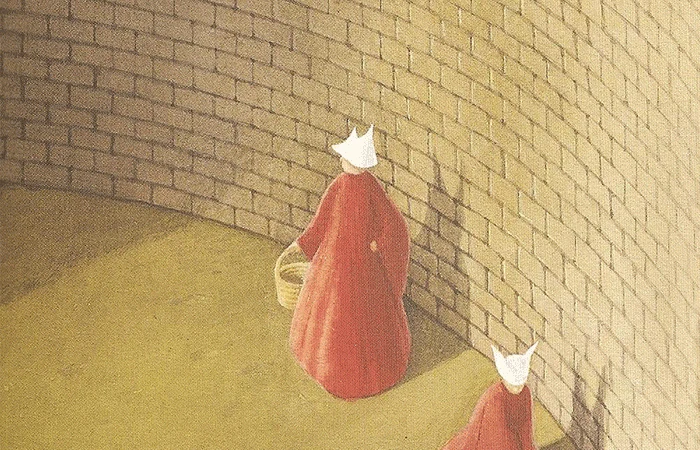
When Margaret Atwood’s The Handmaid’s Tale was first published 30 years ago, New York Times reviewer Mary McCarthy didn’t think much of it. She deemed it “readable,” that literary side-eye of yore, and said (albeit apologetically) that it “lacks imagination.” She finds the characters flat and the set-up unbelievable, and complains that it ” does not tell me what there is in our present morés that I ought to watch out for unless I want the United States of America to become a slave state something like the Republic of Gilead, whose outlines are here sketched out.”

I don’t mention this to engage in petty historical comeuppance, but to note how Atwood’s oral history of the repressive post-American country of Gilead, today considered a classic of dystopian—not to mention feminist—literature, was perceived upon publication. The society of The Handmaid’s Tale, with its theocratic enforcement of strict gender roles and reproduction, has become as recognized a metaphor as Big Brother or Soma, instantly recognizable even to people who haven’t read the book. It’s been translated into a gazillion languages and adapted as both a film and an opera(!). It hit a nerve, and continues to do so.

The tale is told from the perspective of Offred, a handmaid in the household of the Commander, one of Gilead’s architects and leaders. Due to declining white birthrates, the government has assigned women of childbearing age to infertile couples; these are the handmaids. Women’s roles are rigorously defined—wives, infertile serving women (called Marthas after the biblical story of Lazarus), disposable “unwomen.” In describing this horrific landscape, Offred is introspective and musing, her emotional responses almost muted. As she recounts in the moment her tightly prescribed movements in Gilead, she remembers, in broken, non-linear passages, the events of “before,” which is how she refers to what we would recognize as modern America.

I first read The Handmaid’s Tale at 15, and while I certainly identified with Offred, there was an edge to my feelings. There I was, at the cusp of making grownup decisions, confident no Commander was going to tell me what to do. Offred never particularly does anything: things happen to her. She’s an odd main character for a dystopia, not particularly rebellious or active. Fifteen-year-old me would have positively died for an arrow-wielding Katniss Everdeen to shoot up the place. Like Winston from 1984, her rebellions is largely in her head (or bed), though unlike Winston, hers is penned in further by her lack of writing (the manuscript we’re reading is said to be recorded on cassettes).

In order for a dystopia to be effective, it has to be plausible, but what we perceive as plausible (if not, strictly speaking, likely) changes through time. Any book set in the future becomes anachronistic as time goes by, but sometimes the futuristic novel can be eerily prescient. Every time someone interviews William Gibson, who coined the term “cyberspace” in the short story collection Burning Chrome, they hassle him for failing to foresee cell phones. By the same token, the saccharine tablets and Soviet cabbage in 1984 read as quaint, but the ever watchful eye of social media has added freight to his two-way televisions, conceived of well before the personal computer.

By my reckoning, using time cues from the novel, we should be about midway through Gilead’s early period, which is about when The Handmaid’s Tale takes place. It seems almost funny, then, to hear Offred remark that the elimination of paper money in lieu of electronic funds is one of the society’s proximal conditions. Credit is a serious problem for many, if not most Americans, though it has more to do with debt load than currency. The various nuclear and environmental disasters of pre-Gilead also feel familiar, if exaggerated. While Atwood’s California is hit with a nuclear meltdown after an earthquake—it was “nobody’s fault,” Offred deadpans—in our reality, we’ve weathered the Gulf oil spill, Katrina, even the Fukishima radiation that reached California’s shores sometime last year.

Reading it now, closer in age to the Marthas (infertile household servants) or Wives than the Handmaids, I see these women differently. In my youth, their motivations seemed theoretical, schematic: See the feminist and the anti-feminist advocate the same policies. While I’m not sure porn-burning feminists like Offred’s mom still exist, I think one needs only to read one of the thousands of op-eds about Miley Cyrus to see her spirit lives on. Serena Joy, the Commander’s wife, was a religious television star of some stripe, not unlike the reality tv stars and female politicians now who publicly advocate a world like Gilead, in sensibility if not particulars. In the book, she is an angry ghost, entrapped by a world she helped create. “How furious she must be,” Offred observes, “now that she’s been taken at her word.” All dystopias start as utopias to someone, ways of constructing society which will solve an intractable problem or eliminate some injustice. There is no random violence against women in The Handmaid’s Tale; all the violence is pointed, particular, sanctioned.

Closing the book as a teenager, I can’t remember what I thought of the epilogue, but this time around, it filled me with a demoralized resignation not dissimilar to Offred’s. The academics of post-Gilead treat her story so lightly—one-upping one another with cute literary references, cracking crude jokes—that I almost long for the earnestness of Gilead, its seriousness. I would never willingly exchange my intellectual freedom for physical safety, but in a post-9/11, post-Katrina, post-Ferguson, post-Charlie Hebdo world, I understand how willingness has little to do with it.

Are there any questions?
On the Beach: 9½ Apocalypses

I recently discovered that all of the posts I wrote for the late, lamented B&N Science Fiction and Fantasy blog have been taken down. I’m going to repost the ones I think worth reposting. This roundup was written in April of 2018, and it’s one of my favorites. What a weird idea for a listicle.

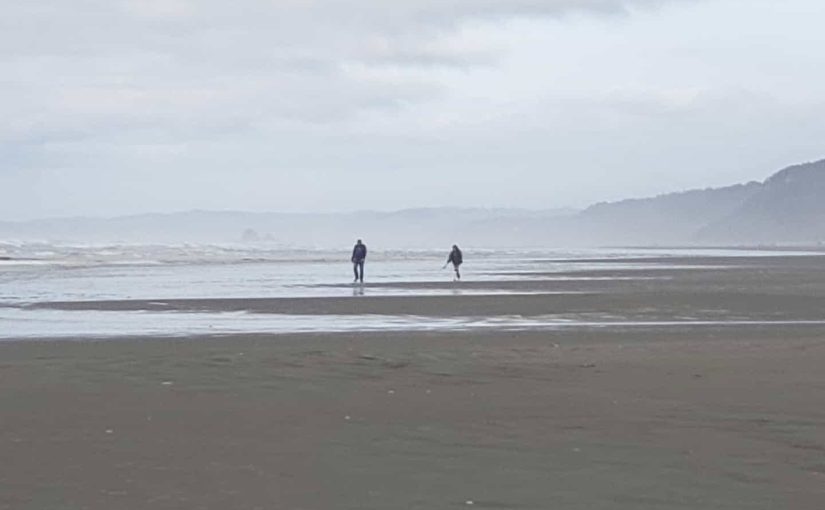
Though I’ve never lived near the ocean, I’ve had a long and personal relationship with the rocky shores of Lake Superior. Though it may not have tides, as North America’s largest body of fresh water, it has the moods and rages of an ocean: playful and quiet one day, murderous the next. My grandparents’ small beach on old Highway 61 (the same one immortalized in the Dylan song) would look entirely the same for seasons, until a brutal storm blew through, picking up a tonnage of rock and tossing it as easily as giants playing catch. The beach was the end of things, both immutable and changing at once, a punctuated equilibrium of geologic forces working themselves out on a day-to-day basis.

In the end, the changing constancy of the hard line between land and water makes a lovely metaphor for the end. Of everything. On the screen and on the page, it’s surprising to think of how many creators end their apocalypses on a beach. Here are nine (and possibly 10) novels that find themselves on the beach at the finale, starting from or working towards that rough edge.

On the Beach, by Nevil Shute
On the Beach takes place in Melbourne, the southernmost major city in Australia, maybe nine months after the Northern Hemisphere annihilated itself in a nuclear war. The deadly radiation has heretofore been kept north of the equator, but the seasonal weather patterns will change soon, dropping death like a curtain onto all of humanity huddled on the southern edge of things. The tone of this novel is strangely quiet. Various people maintain through serious delusion—a young wife with an infant, who worries over a garden that she will never see bloom; a British Navy man who persists in imagining his family alive in England—but no one much bothers them about it. Some drink; some farm; some hold to a chain of command. There’s a gentle humaneness to humanity’s last interactions, in sharp contrast with many other novels on this list.

Which is why it’s strange I found it so difficult to read: the commonplace feel of the interactions makes Schute’s end of it all feel that much more real, that much closer to my everyday, even at a 70-year remove. (One of the reasons even much older end times fictions feel timely is the stripped down technology.) When my mother was in college, during the Cuban Missile Crisis, scant years after On the Beach was published, students hung a banner that read “I’m all right, Jack,” which were words displayed on one of the beaches in this novel—a last testimony of a near-dead humanity, a nuclear age “Kilroy was here.” Oof.

Cat’s Cradle, by Kurt Vonnegut
I read most of Vonnegut in one year-long binge, so it all tends to run together in my mind. Even so, Cat’s Cradle stands out. The plot (insofar as there is one) follows the three children of Felix Hoenikker, a fictional member of the Manhattan Project, which developed the atomic bomb. In addition to shepherding in the atomic age, Hoenikker also, in his free time, engineered a scientific lark called ice-nine, a seed crystal that can convert water at room temperature to ice. The martial and apocalyptic applications of such a thing become obvious with just a moment of thought; consider dropping ice-nine in Lake Superior, or, heaven forbid, the ocean. Vonnegut’s style tends to something both funnier and bleaker than gallows humor: something like satire, but more surreal. It ends, as the world ends, on a beach, with our hapless narrator meeting up with the founder of an ironic religion and unironic Hoosiers both. Though not as explicitly anti-war as Slaughterhouse-Five, Cat’s Cradle nonetheless deals in the horrors of the arms race and technology’s inevitable devastation, right there on the edge.

Wittgenstein’s Mistress, by David Markson
While David Markson is better known as a post-modernist and philosophical writer—the title Wittgenstein’s Mistress being something of a post-modern joke, insofar as that’s a thing—this is explicitly a post-apocalyptic tale. The possibly unnamed narrator (maybe it’s Kate, but who’s to say) types Twitter-length paragraphs into a typewriter at intermittent moments. She’s living on a beach, in a beach house, in a world where all animal life, save for herself, is dead. It’s hard to say how long this has been so; long enough at least for her to circumnavigate the world, go mad, and come back to herself enough to write into the void. If you have a better background in philosophy than I (there’s a lovely introduction in some editions by David Foster Wallace, who has just that) you could find more intellectual delights in this book. Myself, I found it achingly lonely and weirdly prescient, a pseudonymous writer shouting into a faceless and possibly nonexistent void (if that’s not too much of a paradox). Who was your last follower on Twitter? Are they even real? Are you?

(Sidebar: Speaking of DFW, it’s possible Infinite Jest should be included in this list. The last line of Markson’s novel—“Someone is living on this beach”—stands as counterpoint to Wallace’s in Infinite Jest—“And when he came back to, he was flat on his back on the beach in the freezing sand, and it was raining out of a low sky, and the tide was way out.” Wallace’s novel is arguably science fictional, existing in a satirical late-capitalist corporatocracy. The nominal plot involves a video that cannot be looked away from once viewed; a lethally addictive media. You can argue amongst yourselves about the levels of post-modernism and apocalypse in these novels; what fun! Either way, be it apocalypse or not, Infinite Jest ends on that contemplative shore, watching the tides.)

The Wild Shore, by Kim Stanley Robinson
The Wild Shore is Kim Stanley Robinson’s first published novel. It is also the first in a trilogy that imagine possible futures of Orange County, California. (In this, the trilogy is like Ursula K. Le Guin’s Always Coming Home, about a people who “might be going to have lived a long, long time from now in Northern California.” I’ve always liked that complex future tense.) The Wild Shore takes place a half a century after the United States was mostly obliterated due to widespread nuclear detonations of unknown origins. The community of San Onofre is largely pastoral, though through the tutelage of local history-keeper Tom Barnard, its denizens understand something of what the country has lost. When they begin to treat with the more worldly city of San Diego, the real bildungsroman begins, following young Henry (and his fellow citizens) into childhood’s end, both societally and personally. Nobody much writes post-apocalyptic pastorals anymore, but The Wild Shore stands on a strange pivot between that lapsed genre and the later, bleaker version of ash and despair. It’s fitting that Robinson’s first novel starts on a shore, as he, more than any other science fiction writer around, is the writer of beaches: from the final, thrilling moments tumbling in the water at the end of Aurora, to the drowned city of New York 2140, his novels tend to seek out that liminal space.

Oryx and Crake, by Margaret Atwood
Oryx & Crake opens with the self-named Snowman, on a beach, surrounded by child-like primitive humans he calls Crakers. Humanity has been wiped out, replaced by these simple beings. As he hikes inland to the ruined corporate compound RejoovenEsence to forage for supplies, he meditates on how the world came to this state: peopled mostly by antediluvian innocents, except for a few, dirty scavengers who remember the world as it was, as our world, one of technology and literature. The novel moves from the beach inland, which is a notable reversal. Atwood sketches a pastoral that is anything but desirable, and walks the reader back through time to uncover how such a dubious utopia came to be. Leave it to Atwood to rip the pastoral form to pieces; the simple life is not simple at all.

The Pesthouse, by Jim Crace
The Pesthouse occupies a ruined America, half a millennia or more from when pestilence and geological and geological cataclysm toppled our technological society, and follows Margaret and Franklin through the shattered landscape, on their quest eastward to find the ocean, and there, to board a ship to some magically perfect Europe. It is in many ways the reversal of the typical American pioneer story, which heads westward to the promise of open land and new beginnings. (Which is not to say that, historically speaking, the land was either open nor the beginnings new, but this is the American Dream we’re talking about; Margaret and Franklin’s  apocalyptic quest is just as illusory.) They end on the shore after myriad trials, and there must make the choice to continue on to Solla Sollew, or turn back westward to the heart of America. As an American reader, I occasionally bridled at Crace’s use of dialect—that is not how we sound —but there are plenty of observations of the American temperament that simply could not be made by an American (Crace is British), and that I found fascinating. The beach in this one is a mirage, just there over the next hill, where all our American dreams can come true.

The Road, by Cormac McCarthy
We are introduced to the unnamed boy and father on The Road, heading toward the ocean. They’ve been living in a cabin in the wasteland the world has become; all life, down to the bacterial, appears to be dead. Their journey is a grotesque picaresque punctuated by all manner of horrors, but the dream of the sea and its redemption are forefront. The boy and his father are “the good guys.” But when they reach the sea, it’s just as dead as everything else, a slopping soup of iodine and salt. While the beach isn’t the place of salvation the two expect, it still gives the boy his next transition—maybe not precisely from boy to man, but something close and intimate, not unlike an adoption. “In the deep glens where they lived all things were older than man and they hummed of mystery,” McCarthy writes in the final lines. The image of trout in the water is a form of metonymy for the human spirit—cool and deep and hidden, less mercurial than the ocean, but just as vast.

The Forest of Hands and Teeth, by Carrie Ryan
This novel opens generations after the zombie apocalypse, in a society penned in by both the hungry dead and a rigid societal structure. It follows self-involved teen Mary on her bildungsroman, starting with her unlucky placement in her fenced society and traveling out into the wider world after the fences are breached. Mary is an intensely unlikeable protagonist, well more focused on finding the mythical ocean than on the well-being of anyone around her. She learned of the ocean from her mother, who told her fairy tales of water so vast you could never see the end. The one she finds isn’t anything she expected—less a dream than another place strewn with the dead. Her final moments on the beach have a stark, downbeat beauty, even while they lay waste to her childish dream.

The Space Between the Stars, by Anne Corlett
At the opening of The Space Between the Stars, we find Jamie Allenby shivering out the last fevers of a lethal plague that has annihilated 99.9 percent and then some of a human race far flung over dozens of inhabited planets. Jamie sets out on a journey through empty worlds,  attempting to get home to the Northumbrian coast of England, where she hopes her estranged lover still lives. The image of seaglass, tumbled smooth through the action of water and tides, wends its way through the novel, a metaphor for the grinding action of trauma and recovery on our protagonists, and everyone else left. The novel ends quite literally on a beach, alongside people quietly rock-picking their way through the end—and then on to a tentative beginning, putting together the broken pieces of the world.

5 of the Strangest Libraries in Fantasy

I recently discovered that all of the articles I wrote for the late, lamented B&N Science Fiction and Fantasy blog have been taken down. So I’m going to repost the ones I think are worth reposting. This specific post, the one about magical libraries was actually the second post about magical libraries to go live on the B&N site. It was hilarious to me how many comments at the time were like, “what about this other library that was totally on the previous list but I didn’t read the current post before I spouted off.” Welcome to internet comment sections, I guess.

Speaking in purely mercenary terms, writing about magical libraries is a good bet: readers are readers, which means they likely have many happy memories of libraries as safe havens from the world. While I wasn’t always seeking enlightenment when I stole into my local library—I’ll admit there were shenanigans, though nothing truly damaging—I spent a lot of quiet time amongst the smell of glue and paper, the hushed noise of pages turning. It’s an incredible sense memory that is easy to conjure.

Libraries serve many purposes; they are archives of important literature, warm community spaces for people to gather, and handy spots to pickup odious tax forms. Libraries nurture the magic of imagination, and they become that more intense with the introduction of actual magic. Fantasy writers return again and again to the place where they likely learned that magic can seep into our world through the pages of books. Here are 7 magical libraries for you to explore, ranging from comforting and cozy to sinister and scary. (In the interest of not duplicating the efforts of my colleagues, I purposefully didn’t include the five strange libraries on this list. But you should check them out too!

The Sandman, by Neil Gaiman
The Sandman comics detail the lives of the Endless—embodiments of natural forces—most specifically, the character of Dream. Dream was imprisoned for much of the 20th Century, leaving his realm to crumble and decay. The only person not to leave his service in his absence was Lucien, keeper of his library. (Though the library did vanish along with its master.) As befits the embodiment of dreaming, Lucien’s library contains all books even conceived of (even if they were never written), and all the books we’ve lost to the ages. I used to play a game with co-workers trying to cast a Sandman movie: any actor, from any period, at any age was fair game. Every time I think of Lucien’s Library, I play a different, more personal game: what book that never existed do I want to read? The sequel to Fledgling, Octavia Butler’s last novel? The wolf novel that Angela Carter never quite wrote? There are so, so many.

The Invisible Library, by Genevieve Cogman
Cogman’s Library acts as an interdenominational porthole to all possible universes, its librarians tasked with retrieving and preserving the various permutations of great works, or the rarer single volume that exists only in one universe. Because the Library exists outside of time, its librarians never age (at least while they are in the library). The internal politics are, therefore, pretty gnarly. Librarian Irene is a rarity among librarians: she is herself the daughter of two librarians. At the opening of The Invisible Library, Irene is saddled with a new recruit and sent into a restricted world, one where magic and science are in chaotic disequilibrium. By which I mean, the world is steampunk as hell, and just a rip-roaring good time. Great detectives, dirigible chases, shadowy masterminds, a cat burglar, and more await you in this novel, which is, blessedly, the first of a series.

Ink and Bone, by Rachel Caine
Like The Invisible Library, Ink and Bone reads like a mystery and a thriller. The Great Library is a sinister, controlling presence in this world, acting as sole gatekeeper to all of the greatest works of history. The personal ownership of books is illegal, and Jess Brightwell’s family lives by the trade of illegal books. Though much of his knowledge of the world come from this illicit source, he jumps at the chance to compete for a position in The Library. This competition isn’t just a serious of bubble-tests, but something much more grueling and deadly. While we think of librarians as open source heroes—and they are, often—there has always been a kind of librarian who guards information jealously, doling it out by whim, or prejudice.

Alcatraz Versus the Evil Librarians, by Brandon Sanderson
To continue the theme of evil librarians, let us consider the fate of Alcatraz Smedry. A motherless child, Alcatraz can’t but help breaking things, a talent that comes in handy once he discovers that evil librarians are secretly running the world. (Boy, I wish my abyssmal abysmal spelling served a divine purpose.) After receiving his inheritance from his long-lost parents, he’s thrown into a search for the truth. Alcatraz Versus the Evil Librarians plays with children’s quest fictions, skewering tropes while having an absolute ball. I’ll show you to shush me!

Un Lun Dun, by China Miéville
Un Lun Dun is a gleeful riff on Chosen One fiction, compete with a protagonist switch and all sorts of derring-do. At one point, our intrepid unChosen One meets an extreme librarian of the Wordhoard Pit, a truly prodigious mound of books reaching to the sky and beyond. Librarians have to link to one another like mountaineers (“bookaneers”) to find a particularly recalcitrant tome.  Like other libraries on this list, the books in the hoard contain everything that has been written or lost, in addition to being a portal to other worlds. This is perfect: the unbelievable potential of even the smallest library to transport you to another place, setting you on a chain of seeking that leads off to somewhere beyond your horizon.

Lirael, by Garth Nix
The second of Garth Nix’s Old Kingdom series introduces us to the Library of the Clayr, a repository of magical books and items, recipes, weapons, and who knows what else. The eponymous Lirael begins the novel as third assistant librarian in this massive, mountain-bound library, though she doesn’t have the powers of her fellow Clayr. Much of this story takes place within the library, but the sense of adventure is no less acute for being set in quiet, curving place. (I think this one may be my personal favorite, as the sense of secret, deliciously occult knowledge existing just around the bend is particularly strong.) And everyone should have a Disreputable Dog with them on their adventures through the stacks.

The Archived, by Victoria Schwab
This is more an archive than a library, but let’s not split hairs. Mackenzie Bishop is a Keeper of the Archive, where the memories of the dead are bound into Histories. Being a Keeper is hereditary, and Mackenzie has come to it very young, after the untimely death of both her grandfather and brother. Something is going wrong in the Archive, as more and more Histories attempt to escape back into the world of the living. Mackenzie struggles with that, and with her recent losses, patrolling the borders of memory. The Archive is a moody, introspective book, and captures the quiet contemplation of libraries as reliquaries of history.

There are so many magical libraries to chose from…which one suits you?