This review slash rumination was written five years ago, before the term “snowflake” took on specific political meaning. Which is to say: now, it’s a slur from conservatives about liberals, slagging them for being thin-skinned or whatever. Back before the current political shitshow, the term “speshal snowflake” had some limited currency out there in the book-o-sphere. It referred to a character who kept mowing down narrative impediments by virtue of inherent awesomeness, a Mary Sue in terms of plot expediency if not eye color. Pretty much all of these terms are now twisted and/or problematic. So, you know, you’re welcome to my anachronistic musings about urban fantasy novels, half a decade too late.
I’m here today, friends, to talk about the Speshal Snowflake. She’s one of those creatures both more ubiquitous and more soul-wearying than vampires, starring in melodramas in multiple subgenres, both fantastic and literary. Like the Mary Sue, who can be either close cousin or indistinguishable doppelganger, the Snowflake can scythe down impediments through sheer narrative invincibility, the hand of the author cradling her against the slings and arrows. She’s the only person that matters; everyone will love her; all will look on her and despair, etc. The Speshal Snowflake is special precisely because we have been told she is so, and anything she does (or does not do, often tellingly) is special on the dint of this telling, both regardless and irrespective of actual, measurable, ethical worth.
And like the Mary Sue, reactions to the Speshal Snowflake are decidedly gendered. Very rarely, and only in the most egregious of cases, is a male character understood to be either a Mary Sue or a Snowflake. I can’t think of an instance where anyone seriously called Rick Grimes from The Walking Dead a Speshal Snowflake, but it’s all there: complete lack of narrative danger (for Rick), others dying to prove Rick right slash lend gravitas to Rick’s ethical struggles, an almost preternatural ability to fall upwards into leadership roles. I barked out a laugh when Rick was questioned by some nameless Alexandrian in a recent episode, who then got eaten by walkers just moments later. Rick is right because he is right, and the narrative will bend itself around his rightness. Nevermind if it would be well more interesting to see a world where his ethical choices weren’t immediately upheld by the narrative. If the walking dead are like weather, an implacable force that carries no inherent moral force, they they should be ultimately uncaring of any choices anyone makes. No man should be exempt from winds that blow.
But we’re more inclined to call Katniss Everdeen a Snowflake than Rick, even though I feel like their situations and ethical struggles are roughly commensurate in terms of silliness of premise and direness of consequence.The walking dead violate the very laws of physics, and it makes no sense that a teenage girl would be the center of a struggle for empire. Which is I think my point: the walking dead are not weather, they are a narrative device, just as surely as Panem’s ludicrous and impossible political system is a device. Those things aren’t important because story, narrative, is not reality, it is something heightened and purified and concentrated. Let me tell you a tale of people in extremis, and the choices they made. Let us wind up this automaton and let it go.
These nerds once made relationship maps for things like the Icelandic Sagas and Beowulf, charting how often various characters are in relationship with one another. Beowulf looks like spikes radiating from Beowulf himself, while the Sagas were a complex web of relationship, with no one person in the middle. The Sagas, of course, are based largely in fact, and there is not one particular protagonist of this here world. That a story is about anyone at all, in particular, makes them special.
We are, all of us, the leading role in the story of our lives, and when we slip into the narrative skin of these our avatars, we bring our native self-importance into the mix. We bend to the “I”, because we are the protagonist in our stories unfolding. Which is to say, there isn’t especially anything wrong with the Speshal Snowflake. Every protagonist is going to have more or less Snowflakiness in their crusts because that is how fiction works: this person or persons is more important than all the rest, which is why you’re bothering reading at all. It’s like asking why no one shows people going to the bathroom in movies: because that’s dumb, and it’s not in service to the story.
Which is not to say that the Speshal Snowflake can’t get irritating. I found Bella Swan cringingly, horrifyingly accurate to my adolescent sense of self-importance and self-involvement — the way she treats her friends is shabby indeed, just as a start — even though the narrative rewarded her constantly for this awful behavior (insofar as anything in Twilight can be understood as a reward). I just fucking squirmed through most of her interactions with her peers, how every single uncharitable instinct of hers was credited, how everyone else’s interior life was that much more legible compared to how complex and inscrutable she is.
Edward cottons to her precisely because he can’t read her mind, even though we can, and we know. I found this reason for his ardor just hilarious, btw, because literally every boy on earth cannot read my mind, and I certainly didn’t have anyone tripping over themselves to stalk me (more’s the better). There’s something clever about how Meyer sets this up: putting us right in the mind of a boring B+ student of no particular talent, and then making her desirable for something we can all relate to. You know, no one can read my mind either?! And I just got a B+ in English?? We know what she thinks because on some level we thought it as Speshal Snowflakes ourselves, before the world intruded with its elegant and inevitable smackdowns that come in like a thunderstorm as the years tick on. The Speshal Snowflake is someone who has never been confronted with weather, the rain lashing the windows and the electrical wire down on the ground, hissing.
So. The reason I bring up the Speshal Snowflake is that 100% the protagonist of Written in Red is one. She rolls into town with naught but the clothes on her back, on the run from dangerous figures who are unaccountable to the usual societal systems, and in short order finds herself a job, a place to live, and the protection of otherworldly forces. She heals a boy who was irreparably damaged by the loss of his mother, makes friends with implacable and deadly forces, and almost accidentally works a political system to her favor. She is, in short, everything I should hate in urban fantasy. But I don’t.
I fairly love her, and her world. The world of Written in Red is something like the one in Charles DeLint’s Newford books, where crows and coyotes and bears shed skins to walk with us humans; or Robin McKinley’s Sunshine, with its profound alt-history of magic and death. We are on another Earth, where humans exist at the largess of creatures terrible in their needs and powers, and as we humans tend to be, we have to be reminded of that fact over and over. I found the perspective of the non-human characters, who think of us a meat, just terrifying, the kind of thing that slipped into my dreams and conjured up nightmares of being hunted and torn.
Meg Corbyn is a cassandra sangue, a blood prophet, who has been raised as an asset, as a useful source of prophesy for men rich enough to pay for such a thing, and either enrich themselves or feed their predilections. She escapes somehow — no doubt a tale for later books — and ends up in a mid-sized town in the north. Maybe Buffalo, maybe Milwaukee, maybe Minneapolis; big enough to feel more important than farming communities, but too small to really matter (though its residents would never admit it). Another newcomer (and point of view character) is the police officer Monty, who reads like an old school constable, his work more politics and subtle maneuvering than gun handling and force.
Meg follows a prophesy she had to the inner-city citadel of the Others, where human law does not apply. She’s hoping she can dodge the people who have very real incentive to control her prophesies by hiding behind inhuman monsters. It’s not really much of a plan, admittedly, but she’s been very sheltered. She gets a job as the liaison between the Others and the humans of the city, and most of the plot bops around watching her steps and missteps as she navigates her new life. And it’s here where her Snowflake powers really activate, almost effortless making friends and allies among the Others.
But here’s the thing: I resent Snowflakes that are only so because I have been told they are, characters who are demonstrably terrible people who win only because the author deems it so. (Jamie McGuire writes a ton of these heroines, boy howdy.) I have some reservations about late-period Harry Potter, for example, who gets told over and over that he is good, when a lot of the stuff he does, like the shit with Gringotts and Griphook, is completely indefensible. Completely indefensible, and I will not entertain arguments that say that because Harry is good, nothing he can do is bad.
That is the problem with the Speshal Snowflake: when authors lose sight of moral agency. I would have accepted the sequence with Griphook if there had been any narrative stank on it, an acknowledgement that that was a shite thing to do, but maybe the ethical landscape is more complex than good or bad, that growing up might mean getting dirty. That a lot of evil in the world is done by people acting on what they believe to be the right reasons. That’s not what happens. We are sung a chorus of Harry’s goodness. We will not linger on the sizable number of deaths perpetrated on a poorly understood and sometimes persecuted minority who look a lot like a Jewish stereotype, if you get right down to it. Their lives and deaths do not matter.
Phew, I apologize for the freak out; I’ve been saving that one up. That’s not what’s going on here: Meg has very real reasons for why she’s so innocent, why she doesn’t react like normal people to scary, dangerous predators. As a blood prophet, she was kept secluded and helpless. Everything she knows about the real world was through disconnected images and sounds she was taught. If she doesn’t know what a car is, then she can’t describe her visions to the people who control her. At the same token, she can know what a microwave is, but she should not be taught to use one.
Denying her self-sufficiency was a form of social control. That she takes very real delight in learning the simplest of things, like listening to pop music, ischarming, and reminds us readers of the wonder of our everyday lives. I exclaim this quite regularly, but did you know I carry around in my pocket a tiny computer capable of getting me just about any book, movie, or musical recording; it can connect me to others across the globe and on another floor of the house; it can furnish me with information about just about anything. Good god, you guys, it’s like a goddamn science fiction novel. That Meg is fresh and delighted by all the wondrous things we take for granted is no strike against her.
Her existence as a blood prophet is also very subtly done. She’s been told a lot of things about what that means and how she is, and she only slowly starts to question that received wisdom. It’s not even lingered on, but that Meg very deliberately chooses to live in a place where she has seen a prophesy of her own death, that she doesn’t run from the prophesy, is a very cool detail. This is how a prophet would behave, trusting her own visions, letting them play in the hopes that she could turn the knife, instead of avoiding it altogether,
That the prophesy is accessed through cutting, and that all of the blood prophets are girls, is another fraught detail. The other point of view characters condescend to feel bad for her, assign her the blame for the scars tracing her body, but it’s not as simple as they made me do it or she’s pathological. Especially when we begin to understand the true violence perpetrated on her in the home for girls, when her skin was sold out for the scars it could bear. The potential violence of the Others, which is still often terrifying, has got nothing on the violence she’s already endured. She’s a Speshal Snowflake precisely because she understands weather, and the things worse than weather.
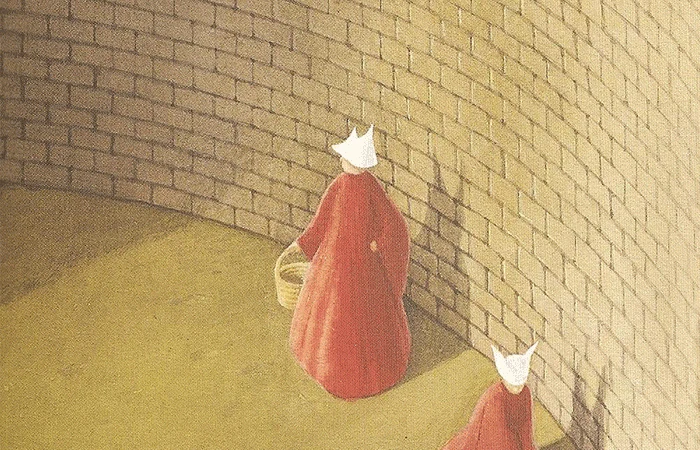
I’ll admit there were moments when I was like, aw jeez, that’s a little too much. A young woman who plays as clumsy antagonist, working for the people who would get Meg back for her prophetic skin, has baldly stupid motivations that are lingered on far too long. Meg herself mentions another girl in the place she came from, an openly defiant girl, and I wanted to hear way more about her. Reminded me, in a way, of Moira from The Handmaid’s Tale, this bright, angry, dynamic personality who lays in harsh contrast with the almost passive protagonists, the special ones.
(I don’t really have this thunk completely out, but there’s something about those minor characters, the throwaways and half-remembered, who have so much life in them compared to the drear details of the average protagonist, special or not. I have a number of fictions I love precisely because of the minor characters, and though this isn’t exactly that, it’s interesting to me that people can often write the incidental more strongly than the important. Maybe their lack of importance makes them easier to write true.)
Anyway, Written in Red was just delightful to me, the kind of thing gulped down in all the space I could make for it, running to its prophetic conclusion. I thought it dealt beautifully with the trope of the Speshal Snowflake, grounded her right in the background she needed to exist, in the parameters she was given. No, of course, magic doesn’t work, but if it did, this is what it would look like. It would look like the storm on the horizon, the one we can never exactly escape, right up until we batten down, and do.