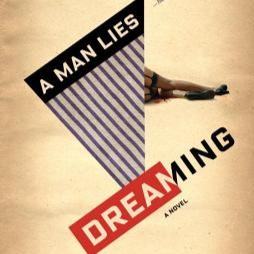
This review was originally posted on the Barnes & Noble SciFi & Fantasy blog on March 16, 2016. It has since been taken down, so I’m putting it back up.
Lavie Tidhar opens A Man Lies Dreaming with a familiar noir encounter: the buxom, well-heeled moll enters the downtrodden private dick’s office and hires him to find her lost sister. The detective is running from his past, one in which he let burgeoning power slip through his fingers, and the woman invokes his memories of that great mistake to needle him into accepting the job. Well, that, and the cash she casually rolls out, cash that he can’t say no to because he’s that close to the edge. His office is threadbare; the street below it is patrolled by prostitutes; he is days from eviction.
It’s 1939, and the communists have taken over Germany after the dissolution of the Reichstag. The detective is Adolf Hitler, now called Mr. Wolf, come to England after a five-year stint in a communist internment camp. The client is Isabella Rosenstein, whose sister was taken by human traffickers as she attempted to flee communist Germany. The culprits are likely old Nazi comrades of our piteous Wolf. “I do not associate with the old comrades anymore,” he tells her. “The past is the past.” But he shoulders his prodigious burden, and sets to finding the communist daughter of a Jewish industrialist.
There are echoes of the Faulkner quote in here—“The past is never dead. It’s not even past.”—and the adage is as true of the plot as it is the form. Mr. Wolf plays the flatfoot through lurid and increasingly pulpy machinations. He comes into contact with former Nazis, politicians, and filmmakers of all stripes, from the English fascist Oswald Mosley, to spy novelist Ian Fleming, to Nazi filmmaker Leni Riefenstahl. England is on the eve of an election, one that will likely see Mosley and his Blackshirts rise to power on a platform of xenophobia and isolationism. The German refugees have to go.
But a man lies dreaming throughout, a man named Shomer Aleichem, who is himself an inmate of the terribly real Auschwitz. His only chance to escape from the waiting, pointed violence of the concentration camp, is to imagine the pathetic, chaotic travails of a ruined would-be despot. Wolf lives through Shomer’s alternate history degradations while Shomer lives through Wolf’s. It’s an ouroboros of alternate history within real history within alternate history. A Man Lies Dreaming is based on escapist fiction, and the man in the concentration camp is most in need of escape. They invoke one another.
Shomer is based on a Yiddish pulp writer—Fiddler on the Roof is based on a series of his novels—who wrote shund: popular, somewhat trashy novels at the turn of the 20th century. The necessity, or maybe more correctly, the inevitability of trash literature concerned with serious subjects is an unspoken theme in much of Tidhar’s work. Theodore Adorno once famously declared that, “To write poetry after Auschwitz is barbaric.” But can we write the barbaric, the comic, and the ironic? When my grandfather told stories of the war, they felt like riddles, with ironic, unfunny punchlines that had me laughing for no reason I could discern. Did I tell you the one time I almost ran the wrong way past enemy lines and into my inevitable death? It wasn’t funny, but, as the saying goes, if you don’t laugh, you cry.
A Man Lies Dreaming is brutally funny, the kind of thing that makes you squirm. The standard for Holocaust novels is seriousness, reverence. Tidhar stomps on all that with big ol’ lace-up boots, the kind you’ll find on the dominatrix antagonist from ’70s Nazi exploitation film. So many people have tried to pick apart Hitler, divine his motivations and sick predilections. In this book, we find chunks of his diary, filled with petty grousing and casual hatreds, interspersed with escalating violence and criminality. It’s the most savage irony, to see a man who based an entire genocide on his twisted notions of inborn criminality bereft of his sick principles, not to mention the power and position to play them out. He’s the foreigner that the rising fascist party in England wants to expel.
A Man Lies Dreaming is a vital, brilliant novel, almost assaultive in its pulp ornament. You have to account for the shund, for the popular and disposable, in a story predicated on the Modern era’s greatest calamity.