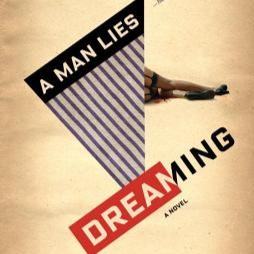
The Past is Twisted into Pulp in A Man Lies Dreaming

This review was originally posted on the Barnes & Noble SciFi & Fantasy blog on March 16, 2016. It has since been taken down, so I’m putting it back up.

Lavie Tidhar opens A Man Lies Dreaming with a familiar noir encounter: the buxom, well-heeled moll enters the downtrodden private dick’s office and hires him to find her lost sister. The detective is running from his past, one in which he let burgeoning power slip through his fingers, and the woman invokes his memories of that great mistake to needle him into accepting the job. Well, that, and the cash she casually rolls out, cash that he can’t say no to because he’s that close to the edge. His office is threadbare; the street below it is patrolled by prostitutes; he is days from eviction.

It’s 1939, and the communists have taken over Germany after the dissolution of the Reichstag. The detective is Adolf Hitler, now called Mr. Wolf, come to England after a five-year stint in a communist internment camp. The client is Isabella Rosenstein, whose sister was taken by human traffickers as she attempted to flee communist Germany. The culprits are likely old Nazi comrades of our piteous Wolf. “I do not associate with the old comrades anymore,” he tells her. “The past is the past.” But he shoulders his prodigious burden, and sets to finding the communist daughter of a Jewish industrialist.

There are echoes of the Faulkner quote in here—“The past is never dead. It’s not even past.”—and the adage is as true of the plot as it is the form. Mr. Wolf plays the flatfoot through lurid and increasingly pulpy machinations. He comes into contact with former Nazis, politicians, and filmmakers of all stripes, from the English fascist Oswald Mosley, to spy novelist Ian Fleming, to Nazi filmmaker Leni Riefenstahl. England is on the eve of an election, one that will likely see Mosley and his Blackshirts rise to power on a platform of xenophobia and isolationism. The German refugees have to go.

But a man lies dreaming throughout, a man named Shomer Aleichem, who is himself an inmate of the terribly real Auschwitz. His only chance to escape from the waiting, pointed violence of the concentration camp, is to imagine the pathetic, chaotic travails of a ruined would-be despot. Wolf lives through Shomer’s alternate history degradations while Shomer lives through Wolf’s. It’s an ouroboros of alternate history within real history within alternate history.  A Man Lies Dreaming is based on escapist fiction, and the man in the concentration camp is most in need of escape. They invoke one another.

Shomer is based on a Yiddish pulp writer—Fiddler on the Roof is based on a series of his novels—who wrote shund: popular, somewhat trashy novels at the turn of the 20th century. The necessity, or maybe more correctly, the inevitability of trash literature concerned with serious subjects is an unspoken theme in much of Tidhar’s work. Theodore Adorno once famously declared that, “To write poetry after Auschwitz is barbaric.” But can we write the barbaric, the comic, and the ironic? When my grandfather told stories of the war, they felt like riddles, with ironic, unfunny punchlines that had me laughing for no reason I could discern. Did I tell you the one time I almost ran the wrong way past enemy lines and into my inevitable death? It wasn’t funny, but, as the saying goes, if you don’t laugh, you cry.

A Man Lies Dreaming is brutally funny, the kind of thing that makes you squirm. The standard for Holocaust novels is seriousness, reverence. Tidhar stomps on all that with big ol’ lace-up boots, the kind you’ll find on the dominatrix antagonist from ’70s Nazi exploitation film. So many people have tried to pick apart Hitler, divine his motivations and sick predilections. In this book, we find chunks of his diary, filled with petty grousing and casual hatreds, interspersed with escalating violence and criminality. It’s the most savage irony, to see a man who based an entire genocide on his twisted notions of inborn criminality bereft of his sick principles, not to mention the power and position to play them out. He’s the foreigner that the rising fascist party in England wants to expel.

A Man Lies Dreaming is a vital, brilliant novel, almost assaultive in its pulp ornament. You have to account for the shund, for the popular and disposable, in a story predicated on the Modern era’s greatest calamity.

Review: Roar of Sky by Beth Cato

Beth Cato’s Blood of Earth trilogy – which began with Breath of Earth, continued with Call of Fire, and now completes with Roar of Sky – has been an incredibly active and peripatetic series. While Roar of Sky does cover at least as much ground as its predecessors – our heroine Ingrid, her lover Cy, and their friend and pilot Fenris move from Hawaii to California to Arizona and several points between – there’s something almost internal about the movement, contemplative and personal. After the pyrotechnics (almost literally) of the climax of Call of Fire, Ingrid is bruised and hurt, seeking answers to deeper questions of who she is and where she came from. Even as she seeks answers to her origins, she struggles with limited mobility and persistent pain from her last encounter with the antagonist, Ambassador Blum, physical disabilities that may likely be permanent. She is coming to terms with her origins, even as she learns – painstakingly, painfully – how to go forward.

We first met Ingrid Carmichael in the weeks leading up to the San Francisco earthquake of 1906, which leveled 80% of the city and still ranks as the largest loss of life from a natural disaster in California’s history (in both our timeline and hers). But while the earthquake may the same, the California it takes place in is profoundly different. The United States and Japan have merged into a larger empire called the United Pacific, and have since waged war on China. As a nation at war, the Unified Pacific is in the grips of dangerous xenophobia against anyone who isn’t Japanese or white American (but especially against Chinese-Americans). As the dark-skinned daughter of a prominent geomancer, Ingrid is both insulated from public animus, and deep in the heart of a system that devalues and judges her. Because Ingrid has a secret: she is a geomancer too.

Which brings me to another key difference between Ingrid’s world and our own history: geomancy, Reiki, kitsune, qilin, sylphs, and all manner of mythical powers and strange creatures exist in world of the Unified Pacific. Ingrid’s closest relationship is with geomancy, a sensitivity and mastery over the seismic power of the earth. This power can be siphoned off by geomancers and locked into crystals, which are then used like batteries to power everything from lightbulbs to dirigibles. This is not just an alternate history, but an alternate reality. Women are not supposed to be able to work geomancy, so when Ingrid’s powers of geomancy manifest during the earthquake, it thrusts her into dangerous geopolitics (pun absolutely intended.)

Roar of Sky begins in Hawaii, where Ingrid, Cy, and Fenris have fled after their confrontation with the kitsune (a fox deity, of sorts) who is living as a high-ranking official in the United Pacific, and absolutely dedicated to the destruction of all Chinese people – both in America and Asia. Ingrid was told by her father that she has a familial relationship with the Hawaiian goddess Pele, so she braves the active geology of the Hawaiian islands (as a geomancer, this kind of seismic activity can be deadly) in order to find out more about her kin. Ingrid is wheelchair bound at times, her nervous system burned out by the overflow of magic she used to protect herself from the kitsune previously. Ingrid’s visit to the crater of Kilauea is tactile and detailed, with the kind of description that feels lived in. She thrills at her feelings of connection with the landscape, even while acknowledging she will never quite be Hawaiian, even if it is her family’s heritage.

Her interactions with Madame Pele are even more interesting. I’ve seen a lot of characters damaged by magic, like Ingrid, who then drag around for a while until they are magically healed. Magic takes, then it gives back. But that is not what happens for Ingrid, even while she treats with goddesses, qilin, and other forces of nature. Ingrid’s legs are permanently damaged, and no amount of narrative convenience or wishful thinking will heal them. Cy and Fenris work tirelessly to fit her with braces and other helpful apparatuses, but even those that work force Ingrid to adjust to her new physical limitations. Never have stockings been more annoying. In a real way, Ingrid is learning to walk again, even as she’s in a flight, and then fight, for her life and those she loves.

As Ingrid, Cy, and Fenris move through the United Pacific, they encounter and re-encounter people who are pivotal to both their pasts and their futures – everyone from Theodore Roosevelt (recast as ambassador in this reality) to Ingrid and Cy’s fathers, mentors, sisters, and friends. Ingrid has always been a likable character, though her naivete occasionally rankled. That naivete has been dampened by the real limitations she’s encountered, though it never quite goes away entirely. (Ingrid, after all, has been somewhat sheltered.) That naivete – which some would call optimism – is her weakness and her strength, and both are put on full display in Roar of Sky. Roar of Sky is as much the story of empire as it is of one woman, and her journey both within and without.