Day by Day Armageddon

When I was in the 8th grade, my English teacher pulled one of those Lord of the Flies-style writing experiments on us. I have this feeling that the background of this writing experiment had something to do with House of Stairs, which we read at about the same time. House of Stairs is an oddball little YA fiction which is about a group of children being ‘sperimented on by a totalitarian regime which includes, I believe, a taxonomy of personal ethical states which caused a fair amount of consternation. (I should really reread that, because a lot of it has drifted in the intervening *coughcough* years.) 

Anyway, the writing experiment had us pretending to be on a plane going on some kind of exchange program, but then the plane crashed and we were all stuck on a desert island without any adult supervision. We were split up into groups, or I think more accurately, we split ourselves into groups, and then went wandering off in search of food or shelter or whatever. The teacher would periodically lob pieces of paper with events scrawled on them – a storm, or an attack of bees or something – that we would have to incorporate into our teen survivalist narratives as we wrote furiously about how we found a pineapple tree so we wouldn’t starve tonight. (Editorial comment from the teacher: pineapples grow on bushes.) 

We never did split into factions and try to kill each other, at least within the confines of the survivalist teen story playing out in class, though I think it would be accurate to say we were already split into factions and trying to kill each other in real life. The teacher – whose name I’m struggling to remember – would explain certain things in her lobbed paperballs – like how we were all suffering from some kind of poisoning because we weren’t boiling our water, and then we’d duly figure out that we should be boiling our water and incorporate it in our stories. It’s kind of embarrassing how we just went for the most obvious physical solution to whatever trouble she tossed our way, totally ignoring the very real, very social-combat stuff we were living day-to-day, but then we were 13, and she was kind of a psycho for trying to get us to kill each other fictionally. The writing experiment ended with Zuckerman getting eaten by sharks after going mad, and then we got rescued. My frame narrative was that I was in a psych ward, having gone nuts after my experience on the island. I’m sure my story was hugely insensitive to actual mental illness, but then it doesn’t exist anymore, except as a half-memory, so I’m safe. 

I thought of this teenage writing experiment when I was reading Day by Day Armageddon, being the point of this anecdote. Our possibly unnamed narrator – though I wasn’t paying close enough attention to key on a name-drop – starts a diary on New Year’s Day after being sent back to San Antonio on leave from the US Navy. He chats a bit about Christmas with his folks in Alabama (or possibly Arkansas; I can’t differentiate between the two because I’m a sucky Northerner) then sketchy stuff starts happening in China, then the US. Narrator dude seems to have a preternatural sense of when to fortify the house, like someone were lobbing authorial information from on high, which he does with an outrageous attention to detail. I believe he even specifies the size of drill bit when he screw-guns some plywood up on the lower windows. 

Narrator dude – forthwith to be ND – hangs out in his house a lot, obsessively watching tv, trying to get through to his folks, and rationing his MREs. The walking dead start hanging around the house, so he dispatches them with fire in a way that seems like it would end in the neighborhood getting torched, but whatever. He eventually meets up with a neighbor – an engineer, you know – and then they picaresque around the zombie apocalypse hijacking planes from small airports and trying to find a safe place to be. ND and neighbor (Dave?) end up on an island for a while, which seems like it might be sweet, but then the island is big enough to have a shitton of walking dead on it, but too small to have much in the way of necessary foodstuffs and whatnot. 

So. Before I start and-then and-then and-then-ing like this novel, I should probably pull back and talk about some higher level shit. I read the first maybe third of this novel a half dozen years ago, when Bourne was writing it as a serial internet narrative thing. This book was one of the early Internet book phenomenons, back when such a thing was notable. (And I’m using the term “phenomenon” pretty loosely, but his blogging did result in for realz publication, which was something back in the day. Maybe it is still notable; I don’t know.) I didn’t want to go on with it at the time, because it’s so…hokey? straightforward? but then I recently decided to check out the really pulp edges of the zombie genre, and here I am. 

The shitty editing and overall bollocks of this novel can be chalked to its diary format, which makes me a little resentful of the diary format. Is it fair to give embarrassing grammar a pass just because the book is supposed to be a diary, and it’s not like people bother with grammar all that much when they don’t think anyone is watching? I’m going with no, because despite the cutesy intentionality of all the scribbles and underlining, typos is typos, and those are some fucking typos. That said, this was a delightfully wonky read written by someone who obviously knows his way around various hardware. I’m going to guess that Bourne himself is a military dude just like ND, and there’s a lot of really detailed descriptions of guns & ammo, and a refreshingly sensible take on how things might work, or not, in the zombie apocalypse. He calculates head shot radios and amount of ammunition left. He nerds out on tech. 

There are zero characters – not even ND, who is more a collection of MacGuyver-like skills than a person – but the narrative occasionally slips up into something like a voice. ND has ticks, like the phrase “no joy” when something goes wrong, but he’s pretty squeamish about emotions. Neighbor-possibly-Dave has to kill his wife, and starts bugging out emotionally for a while, and while ND notes this, he doesn’t do anything to correct it. It just sort of works its way out conveniently without any comment. Various chapters end with the question, “why am I living?” Which, good one, because other than a few brief moments where things aren’t shit, there’s not much to live for other than gun-cleaning and food-sourcing. Even the action scenes are bloodless, and often rushed to the point of not registering. 

So, this was fun to read on a hangover Sunday, but it’s not, like, good on any kind of technical level. Cool, arresting images are squandered, like the zombie on a crucifix thing which might be becoming a trope, and was dealt with insanely awesomely in Zombie in a Penguin Suit (Question: what’s black and white and red all over? Answer: AHHHHH.) A number of events parallel This Dark Earth, but that has a ton more style, and actually engages the diary format in one of its sections as a device. (But Wittgenstein’s Mistress blows everything out of the water in terms of post-apocalyptic diary format, not that it’s even fair to mention.) I don’t really care where this goes, because I have no one to invest in, but it was fun while it lasted. It’s almost refreshing to read something so little interested in the questions of what makes us human and how to construct a reasonable society in zombie fiction. I’ll just be here running the numbers and cleaning my guns.

The Secret of Ferrell Savage by J. Duddy Gill

You know, I wrote this whole ridiculous review where I hand-wrung about middle grade fiction, but that was lame and I’m glad it got lost. I’ll just note, in lieu of recreating said hand-wringing, that middle grade is a tough genre for me to assess, because it’s so totally not aimed at me, not just in age, but in reading and worldly experience. While the big life themes are of course present for the middle grader – how to deal with your parents, and friends, and sometimes even romantic love, the constant whooo-ammmm-III? – it’s just odd for an adult to remember being a child with the child perspective on all that stuff. 

My ten year old and I occasionally swap books for the MG set – him being a middle-grader and all – and we rarely agree about what is awesome. Adam Rex is a winner for both of us, because he’s funny and, maybe more importantly, a weirdo, writing just the strangest narratives. I mean that decidedly as a compliment. (Also, of note, I drunk-friend-requested Rex on Goodreads once, and he was gracious enough to accept and put up with a slobbery PM from me. The boy still bugs me to send him more PMs, but the sober light of day has prevailed heretofore. You’re welcome, Adam Rex.) Anyway, point being, I think this might be a winner for both of us. I’ll have to slip it in next to his bed and see what happens. 

Ferrell and his neighbor and good friend Mary are preparing for the annual sled race at the start of the novel. Mary is bossy and driven, the way girls are before the whole Ophelia death-trap of adolescence. Ferrell is much more happy-go-lucky, good-natured and not particularly competitive. Mary has decided she’s going to win the fudge (only I didn’t actually say fudge) out of the race, carefully constructing a sled out of a wash basin – the race is of home-built wacky sleds, not just your usual red runner – and Ferrell, true to form, leaves his sled-building to the last second. After the race, some family history comes to light for Ferrell and Mary, and no more about that because spoilers. 

I kinda love Mary and Ferrell, the whole darn it, Ferrell, pay attention!! from Mary, and Ferrell’s whole gosh, Mary, sorry which is then tinged with irritation. I like these stories about the odd changing moment in male-female friendships, where you very subtly realize that your bff for forever is a girl, and you are a boy. (Or vice versa, you know.) It’s not the relationship has to go all romantic or something, just that there’s this tiny shift, along with a dozen other little shifts in how you perceive your parents and your peers and all that. 

The Whole Stupid Way We Are and Breadcrumbs rocked in depicting this shift, but I think they’re probably, um, how do I say this? too literary for the fart-joke set. Maybe in another couple of years when my boy is actually going through this shift. (Though there are signs it’s happening; heaven help him.) I think The Secret of Ferrell Savage is going to be a win for the boy because it’s really cleanly written, and it’s about sled racing and cannibalism. Goofy goes a way long way in holding the attention of ten-year-olds, and while the sled-racing and cannibalism is treated earnestly in some ways, Gill doesn’t veer to precious or dour. There are great Dickensian names, like the titular Ferrell Savage, who is a vegan, or the nemesis, Littledood. 

But then also, I just love stuff like this, in a conversation between Mary and Ferrell during the crux of the whole thing. No spoilers, I promise:

“I wonder why there are so many movies about vampires and none about cannibals. They’re both gross, no matter how cute they guy is who’s biting you.”

Then I said, “I think sucking blood isn’t as gross, because you don’t have to chew. There’s just something about having to floss all those little arm hairs and bony pieces out of your teeth that kind of ruins it for me.”

Out of the mouths of babes, man. My Grandpa would hate this, because he was one of those red-meat-and-potatoes guys who thought anything that suggested that vegetarianism was okay – veganism hadn’t been invented in Pennsylvania in the 80s, though it may have existed elsewhere and would have driven him nuts – was the work of Communists. Watching the movie version of Babe: The Gallant Pig with him was a frustrating experience, I’ll tell you what, and I’m not even a vegetarian. So it was cute to have Ferrell be a vegan and not have it be this big thing either way. Or it is a thing, but not the way you expect. Also, Ferrell and Mary pretty much nail the vampire craze right there. Booyah. 

So I hope I can get the boy to read this, because my reader’s advisory hasn’t necessarily been the greatest, but I’m learning.The Secret of Ferrell Savage is undoubtedly the most adorable novel about cannibalism ever written.


I received my ARC from the publisher, but no conditions were put on my review. 

Starglass by Phoebe North

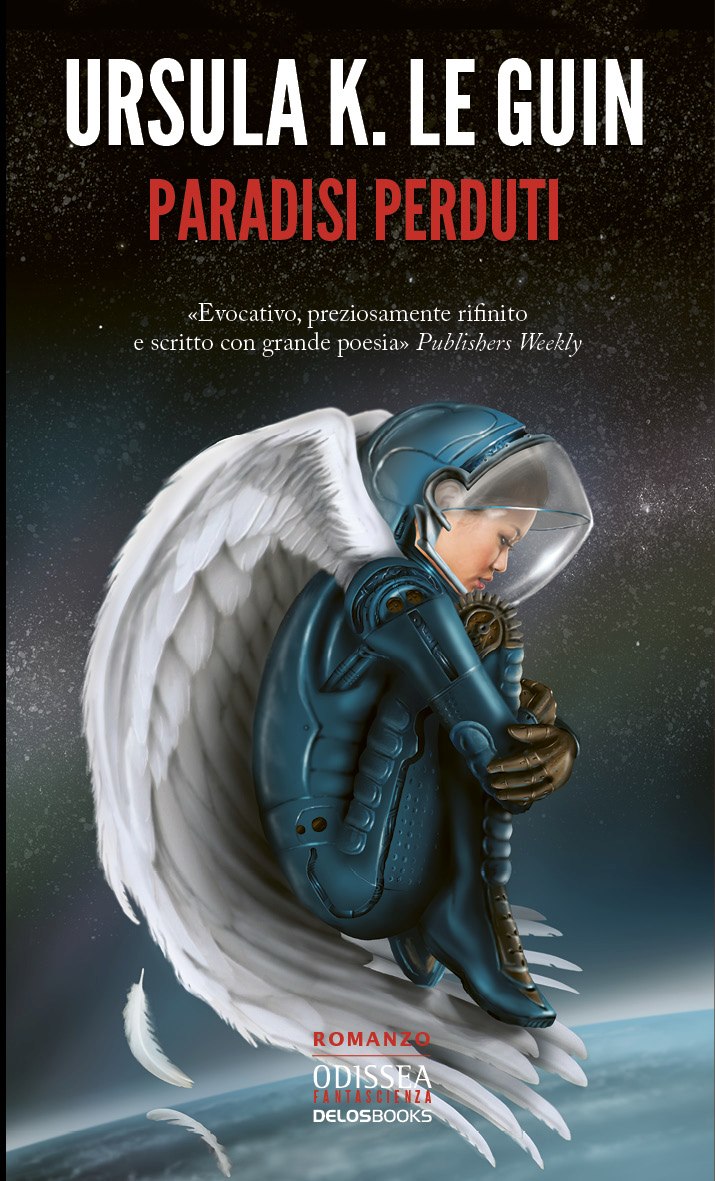
The Italian cover for Paradises Lost,
the generation ship novella by UKL

The whole concept of the generation ship flips me out. I’m not even that comfortable with the idea of being on a spaceship (or a submarine) not because of claustrophobia, but because is there air out there?? NO THERE IS NOT. I just spent nearly four days in a blackout that had me boiling water for baths and kiting power from the neighbors (who had power due to the inexplicable ways of the city grid), and I’m keenly aware of how tenuous our systems are, how it took thousands of technicians pulled from as far away as Colorado to get me back into hot water and an icebox. And with my power outage I won’t be screaming silently into space as my lungs freeze

While most stories occurring on generation ships don’t focus on the technological fragility of a ship ginned up and sent out for hundreds of years into the void, that trapped and helpless feeling is in everything. Here are a thousand people whose living space was chosen for them, irrevocably; there will be no technicians from Colorado when things go wrong. Power structures, of all kinds, must be managed and cared for by people whose lives are by needs insular and rigid. Everyone must do their part because the alternative is not chaos, but death. (Just as a sidebar, this argument gets made politically here on Spaceship America a lot, which is part of the reason that the extremity of the generation ship resonates for me so well. Just because all members of society must contribute what they can doesn’t mean injustice has to be a part of that contribution, etc.) 

Starglass starts, fittingly, with the letter of one of the first generation, the earth-born who left a doomed planet Earth, writing to her daughter about her lost planet and the unknown future. I kinda don’t get book trailers – or maybe it’s just the ones I’ve seen are a little dopey – but this book trailer captures the elegiac tone quite well. We then meet 12 year old Terra on the morning of her mother’s funeral, the very beginnings of the grief and fracture which will color all the events of the novel, the relationships and personalities. 

The heart of this novel is grief, and as such, it makes for a more musing and introspective young adult novel than I think is typical. We meet Terra again at 16, on the eve of her graduation, where the government of Asherah metes out the living assignments for the graduating class. Her home life has turned into a cold war punctuated by emotional violence, an emotionally distant and voluminously alcoholic father clinging to his concept of societal mitzvah in lieu of real parental connection. The dad kind of killed me, the way it seemed obvious to me that on some level he loved his daughter, but he was so badly broken that it came out in these awful, inexcusably cruel ways. That I can have sympathy for him and still hate him and the things he does to Terra speaks to subtle characterization, this horrible, sad, broken, dutiful man who has pasted himself back together using his most selfish instincts. 

As befits a coming of age novel in a locked room society – remember, there are no technicians from Colorado – much of the plot centers on Terra’s growing political sense as she adjusts to her new work life. (And her work placement is an almost clustercuss of mistakes and silences that flow out of her learned self-containment as a result of her mother’s death. Say it with me: the personal is the political.) The people of the starship Asherah are Jews of a post-apocalyptic diaspora, who are, in a way, looking forward to yet another diaspora when they reach the new chosen land of their target planet. That day is coming soon, and the tensions between various factions, who will lead, and who has the right to all comes to bear not just on Terra, but everyone around her in ways that are confusing and personal. 

I feel much more closed-mouth about books I review beforethey are published, so I will just gesture to my contentment about how Terra manages her romantic life. The society on Asherah is rigid in the ways it constructs family life – everyone will marry, and have two children, a girl and boy, when they are told to do so – and that this does not and cannot work for many is maybe only a surprise to the young, who have been locked into their own family failures, cut off by silence and fear that they are the only ones. Here on starship My House, I have a girl and a boy and a husband, and a series of conflicts that I live with without ever updating to facebook or disgorging to the uninitiated. We lock ourselves into our choices and habits, and some of those choices are beautiful, and some of them abrade, and we pick our ways between the two as best we can. 

Anyway, as a conclusion, I just want to note that, as much I loved the shit out of the careful, grieving tone of this story, the personality driven conflicts, and the slow understandings that unfold, as the first part in a duology, the ending might be abrupt for some readers. Really though, it is my firm belief that in young adult novels, the leap is as important as the landing, and Terra’s leap is a sight to behold. I’m more than interested in seeing where she lands, but I’ll hold her there, in the darkness, struggling towards the promised land. 

Full disclosure: I am friends with Phoebe North on Goodreads, and I received an ARC from the publisher, but no cookies were promised or exchanged for my review or opinion, which is decidedly my own.

All Politics is Feudal: This Dark Earth

So, I was recently watching The Dark Knight Rises, and laughing to myself about what a brilliant expression of post-9/11 fascism it is. I don’t mean the term “fascist” in its sloppy usage of “stuff I don’t like” or “dad”, but the more old school definition of authoritarian militarism that positions the arbiter of justice not in law, but in an idealized übermench, you know, with your usual racial and nationalistic overlay on what makes the mench über. Bad guy Bane talks a lot of shit about giving power back to the People — invoking the dialectical enemy of fascism, communism — but as a fascist tract, there is literally one person who might be considered “the people” with a speaking part, and that’s Catwoman’s wing-girl. She has maybe three lines. The police state and the über-police state are pretty much the only important players in a city of 11 million, the People existing either to cheer Batman or drag rich people from their homes dumbly. It’s pretty much a Leni Riefenstahl film, both in terms of ideology, and stunningly beautiful fascist aesthetics.
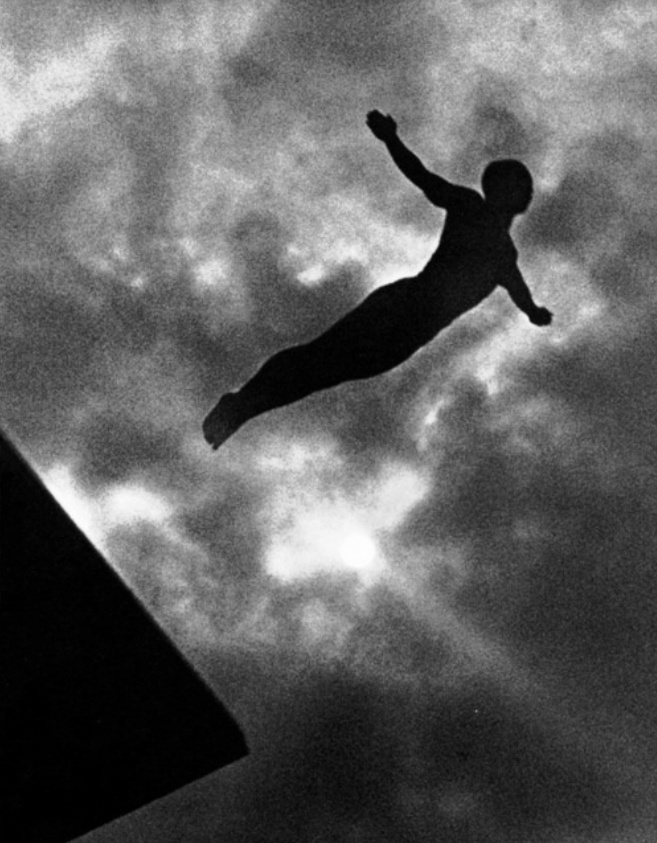
A black and white photo of a black figure in a diving pose against a background of moody clouds

A diver in the 1936 Olympics, photographed by Riefenstahl

Putting aside some lumpy plotting — which no doubt was caused by Heath Ledger’s untimely death after so perfectly capturing hysterical nihilism in The Dark Knight (and I’m glad they didn’t re-cast the Joker) — The Dark Knight Rises brilliantly expresses the not-so-latent fascism of the superhero story. It’ll be interesting to see what the Nolanizing of Superman comes up with in Man of Steel, because Superman was your granddaddy’s very first anti-fascist American fascist superhero. (Sometimes you gotta fight fascism with fascism, apparently.) Somehow I don’t think it’ll work, because Superman is boring, and the best fascists have some chutzpah. The old fanboy saw is that Kent is the disguise, and overpowered aliens posing as dorks are hard to put the banners up for. Squeeze out that single tear, fascists, then we’ll root for you.

Anyway, some what belabored point being that I was reading This Dark Earth at the same time, and kinda musing to myself about all the post-9/11, fear state, how-will-we-maintain-our-humanity-in-the-face-of-terror that I see as endemic to the zombie narrative. This Lord of the Flies with cannibal corpses has been going on at the very least since 9/11, but certainly bubbling there in Romero’s game-changer, Night of the Living Dead, where he rips the shit out of the American nuclear family and societal structures, and probably even earlier in your older school Voodoo sorcerer controlling reanimated slaves folklore. (Sophomore level paper topic: taking the farmhouse in Night of the Living Dead as a structure that symbolizes the Freudian psychological model — id as basement, ego as main floor, superego as attic — map the movement of the characters within this landscape as pertains to societal construction. Et cetera.)
So, This Dark Earth is, in some ways, a very traditional zombie story, starting in a hospital becoming overrun as the doctor very slowly accepts what is occurring around her, complete with zombie infants and a chemical dump outside of town. A basement-bound reunion of mother and child, a bullet in the brain of a turned husband, a military group using a woman as rape fodder and mama, a barbed wire settlement slipping towards feudalism, a girl writing notes that she’s sure no one will read — it’s all there, and more — the wrangling and hand-wringing of the boy grown into a world with new rules, the prince of this new dark earth. The steam train. The slavers. Jacobs hits all of this, lightly, humanely, with an eye toward the individual that I feel gets lost in a lot of zombie stories, somewhat perversely. Even with very large time shifts, the pacing is furious while still managing a tightly personal tone.

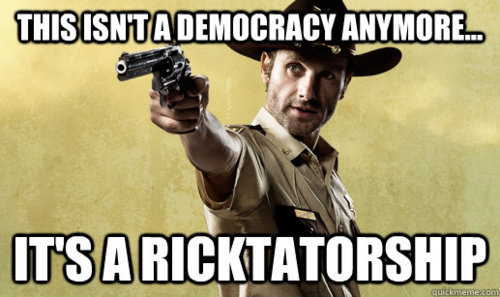
A lot of people are going to invoke AMC’s The Walking Dead with this book — and I guess I am too — but this book checks a lot of the stupid societal bullshit of that show: Rick shouting about how “this isn’t a democracy” and then getting his ass bitten by eye-patched demagogues (but not literally, of course), Carl turning into a squint-eyed tiny badass, the rheumy moral mouthpiece wondering “but at what cost?” I’m still into Walking Dead for the set-pieces, because those continue to thrill, but I have no patience for the people or the society of that show. And I’ve lost patience with the characters of The Walking Dead because it never comes out and owns the inherent fascism of the zombie survivor community, not with any finesse anyway. Breathers are all imbued with exceptionalism in the zombie apocalypse. It’s numbers; that’s all. But on The Walking Dead, Rick gets to be touched with the invisible hand of narrative superiority/safety, lending his leadership a sort of unassailable divinity that should just suck it. This Dark Earth addresses that impulse to feudalism, and it does so while being beautiful in an unshowy way.

I almost don’t want to recommend it to your average non-horror reader, because I think what Jacobs is doing is subtle, this slow, personal invocation of all the tropes of the genre, that sets them all up and knocks them all down, slowly, like a steam boiler, like cancer. Death is the greatest democracy there is; we all have our one vote. Survivalist groups in the zombie apocalypse are often pictured as Spartan paramilitary camps set against the undead Athenian mob. I think that we tend to conceptualized survival this way shows our instinct towards feudalism — the dictatorial Governor in The Walking Dead growling about terrorists, the slaver in This Dark Earth looking for a king to behead. Both Carl and the “Prince” here are positioned as the members of the New World Order, unable to remember the world before the mob, groomed in violent expediency to threats both real and imagined. I’m not sure where The Walking Dead is going to go with Carl, but I have my suspicions, and I’m already girding my loins for disingenuous speeches about honor and stuff.

this is not a democracy anymore, it's a ricktatorship with an image of Rick Grimes from Walking Dead

Observe Jacobs, instead:

The world loves a tomato because it’s red. The apple is red too. But the tomato’s flesh is the flesh of mankind.

Do the dead love the flesh of man because it is like a tomato? We’ll never know. But I have my suspicions.

As the matriculating Prince observes as he filches tomatoes from their tenuous garden. There are times when this is too much, like in an overtly symbolic sequence that has our boy crucified, quite literally, on an exit ramp sign, but then Southern Gothic (which this book is also, in many ways) often can’t help its dips into histrionic religious imagery. Jacobs runs this linear and time-skipping narrative hand-over-hand, from one point of view character to the next, which I believe works beautifully with the stakes and danger of the undead-filled world: you will hear this voice, but you will not know when this voice will end, or if it will pick up again on the edges of another person’s story. Knock-out’s sequence, and the boys on the steam train were especially tight. (And I have another sophomore paper topic ruminating about the train as it fits into the American landscape as some kind of echo of industrialism and colonial expansion, but I haven’t worked out all the kinks.) Certainly, This Dark Earth isn’t reinventing the wheel in terms of zombie narratives, but I thought it dealt with the tropes in a thoughtful manner, which for me can be much more enjoyable than genre-confounding gimmicks or the like. I, for one, welcome our zombie apocalypse feudal overlords, at least as described by John Hornor Jacobs. Hail to the king, baby.

Love & Zombies by Eric Shapiro

Love & Zombies by Eric Shapiro is one of those things I haven’t known what to say about because experience isn’t reflection. I enjoyed reading it, but I’m not sure I can say anything smart about it. I blew through a bunch of novellas all in row, which made me have a whole thing about what makes a good novella versus a novel or a short story, but then I waited too long to write any of those thoughts down. But let’s see if I can recreate some of it. 

First off, the novella is a funny beast, occupying an odd middle distance. Novellas can fail in a lot of ways: not concise enough, meaning they should have been cut to a short story, or taking on too much, meaning they should be a novel. (And the latter might not actually be true, because some of my most hated books were expanded from short stories and/or novellas.) I feel like this book fell into the latter category, in that there was a lot going on, but expanding this scenario would only weaken it, while the specific aims of the story needed a little more time. The most successful novellas I’ve read often occur in already established worlds, so the exposition is just gestural, and then we can go from there. It was the exposition stuff that didn’t work so great for me here, so. 

Love & Zombies starts with a very satisfying first person voice: self-effacing while self-aggrandizing, and just freaking funny. The way he introduces you to the other characters – a girlfriend, an asshole best friend – was really grand, with a lapping, anecdotal quality I enjoyed. Turns out the asshole friend wants to pull some ill-conceived and unethical job for a cuss-ton of money, and our protagonist goes along with it for pretty stupid and illogical reasons. Which was okay by me, because I’ve certainly done stupid things for stupid friends, and I’ve probably stupidly entreated friends to do stupid things for me, and sometimes they’ve even gone along with it. Childhood friends especially, because even though we were just friends because of proximity, when you think about it, nostalgia plays its ugly hand.

The set up is very pulpy, and therefore pretty bananas. Main character dude is feeling emasculated because his hot girlfriend is possibly too GGG, and he’s not feeling worthy of her. This kind of amazing perfect gf for an admitted loser could piss me off, but our MC actually acknowledges that his feeling are dumb, and doesn’t put his crap on her. The stupid, unethical thing in this case is to drive out into the Nevada desert from California, find a zombie, and then squire her to Las Vegas, which is where everything, in pulp style, goes even more pear-shaped. 

Oh, did I mention there were zombies? This being one of the things that didn’t work so great for me in this novella. Apparently there have been zombie outbreaks all over the flyover states, but places like southern California have heretofore been untouched by the zombie plague. Which, fine; maybe my irritation with this set up is that I live in a flyover state full of zombies, so this sort of coastal insouciance about the zombie plague reads a little lame. I think it works in the whole personal metaphors of the main character, so it’s fine, but it doesn’t work on a nuts-and-bolts nerd world-building level. I guess I’m just saying that the world doesn’t make any sense, except as a personal metaphor, which is why this both works and doesn’t as a novella. You can’t expand it, but you can’t contract it either. 

I’ll just say: I liked the voice on this thing a lot. The main character is right: I may not like him, but I love his girlfriend, or maybe I just like how he talks about his girlfriend. (Which is another thing: as much as he talks about the girlfriend, I didn’t feel like I got enough screen-time from her to really dig her, except as a construct of the protagonist. Which is also fine, on some levels, because it’s about him thinking about her and not her. Just, it would have been nice to get a third act snap where you see what he says about her from a slightly different vantage, which would be her vantage. First person though, whatever.) 

I liked the near-zombie girl and the throats she rips out half-pretending to zombification. I also liked a lot of choices made by the protagonist, because while nostalgia may be sweet, his friend was a huge asshole. I’m not enamored of the tie-up, which read too cutesy perfect for me. Maybe the average novella should end with blood on the floor, because we don’t have the investment in your usual novelistic HEA. Maybe. It’s possible I’m bloodthirsty in my needs. 

Two of the novellas I read in my novella week were DarkFuse titles: this and Worm by Tim Curran. Worm was decidedly more about gross pulp thrills, while this was more voice-driven, with a chatting, hipster douchebag protagonist and his admittedly stupid problems. You could almost smoosh them up into a single hot novel, something with killer voice and killer kills. I kind of did that by reading them back to back, which I would recommend. The nice thing about novellas is you can put them down in a sitting, much like a zombie. Love, however, takes more than a headshot to vanquish. A worthy take-home, all told. 

Thank you,NetGalley, for the ARC. 

Wittgenstein’s Mistress

“In the beginning, sometimes I left messages in the street.” 

There’s an old saw, deployed in freshman (or maybe more properly sophomore) English classes about first lines. They set the tone, or gesture to the plot. They are a sign pointing off to the castle. “It is a truth universally acknowledged, that a single man in possession of a good fortune must be in want of a wife.” One rich man (and, in truth, several) will marry in the course of the novel. So here in Wittgenstein’s Mistress we have a woman, in an world empty of people (and, eventually, we learn of all living creatures) writing her life as a signal to whomever might be there, which is, also eventually, no one. These street-messages were written before, when she was still searching, and when she was, coincidentally, mad with her aloneness. So many years have passed that the woman who looks back out from the mirror – a mirror she once signed, in lipstick, with a name that keeps changing, because she would only and ever be the person looking back from the glass – the woman who looks back from her from the mirror is her mother. 

She burns a house to the ground, and lives in its double. She worries, rightly, that the burned down thing that once was a house is still called a house by her. There is no one else to call it a house, or a ruin, or anything at all. 

Speaking aloud is a form of madness. 

It’s dangerously easy to fall into the single-sentence paragraph style of this book, which, to be frank, irritated the fuck out of me at first. I sat on my porch, in the midst of my life, half-managing the political machinations of several neighborhood kids and my own as they shot each other with Nerf guns and played princess, often at the same time. (Medicis would understand, but with poison.) 

Don’t make every thought a paragraph.

But then I went to the cabin. 

Where certainly not every thought is a paragraph, in truth, something more like all thoughts do not collect into paragraph drifts of connectives. There was a grouse in the grass, and she and the grass were almost the same thing, but she was eating out the grass and craning her neck to watch me even though I only moved to smoke the cigarette I was stealing. My daughter ran up and caught me smoking and the grouse vanished like a magic trick, not even exploding off into flight, but shifting to become more like grass in the moment it took me to address me daughter and turn back. Who was I stealing the smoke from? 

I think this novel would be a brilliant Twitter feed, or a tumblr with the Impact font of the lolcat:

In the beginning, sometimes I left messages in the street

I think this novel predicts the solitary madness of social media.

I don’t expect linearity or conclusion from the single-line status updates of my avatared friends, even this word adrift to mean a collection of real friends, acquaintances, colleagues, and people I don’t even like. If they were all gone, I might gossip about people who were all gone, all gone so long their fame left a collection of single-sentence anecdotes about them. I would continue my updating of my status into the great ugly void of an empty world, which would only be ugly because it was a void of people to speak my madness too, not because it wasn’t beautiful. There would still be grouse-like grass I could steal a smoke from, though never an interrupting daughter, which is where the sadness comes in. 

Last lines are their own riddle, in all truth. 

“Someone is living on this beach.” 

The Best Man by Kristan Higgins

The Best Man was an idle Netgalley request which I read also idly, over the course of some time. Probably not the best way to read such a thing. The set up and a lot of the characters are very romantic-comedy broad: Faith was left at the altar years before by a dream boyfriend, Jeremy – high school football star, dreamy, caring – when he was outed as gay by his best friend, Levi – wrong side of the tracks, taciturn. She returns home to her screwball small town to keep her dad from marrying a “gold-digger”, which gives her the opportunity to work out her past with the gay ex-fiance and the meddling best man.

Her relationships with the former fiance, now a dreamboat doctor, and the best man, now an honorable sheriff, are the best parts of the book, but especially the former fiance. These three have history and weight behind their relationships, and it was really nice to see the process by which Faith forgave and came to terms with Jeremy. She and Jeremy have the sweetest relationship in the book. Levi was a little too much in the mold of Sam Shepard in Baby Boom, and I bridle at folksy small-town stuff. That’s really a matter of taste though.

The larger cast of characters was less awesome. There are some squabbling grandparents who I think are supposed to be funny in their bickering, but they genuinely seemed to hate each other and had wasted their lives being stuck with one another. That was depressing. Much of the comic stuff fell flat for me, like a series of first dates that ranged from dumb to offensive. Don’t use trans people as a punchline. The gold-digging girlfriend was ridiculous, and the panic about widowed parents beginning to date again was directed in the wrong directions.

So, a fine little bit of frothy small town rom-com with some sweet moments and some really terrible ones.

Fiend: A Novel by Peter Stenson

About halfway through Fiend: A Novel, I thought, fuck, what am I doing. I’d sworn off drug abuse fiction after Aronofsky’s Requiem for a Dream. Christ, already. I get it. Drugs are bad. (And before you go humorless on me, understand that I’m kidding about “drugs are bad” being the PSA of Requiem.) But good thing Greg sent me a message alerting me to the existence of this, because it’s also got zombies and it’s set in the Twin Cities, two things I pretty much adore when they’re done right. This does them right, in my humble, undead, Midwestern opinion. I always fucking knew St Paul was full of zombies. (Minneapolis might be too, but our heroes never venture to my side of the river.) 

Chase is coming off of a week-long tweak when a little girl tears the throat out of a Rottweiler, then attempts to eat his face off too. Being on the end of a meth binge, he’s not so sure she’s real until his friend Typewriter caves in her skull and sets the house on fire. Like 28 Days later or Rick in Walking Dead, Chase and Type have missed the zombie apocalypse in their altered state: turns out everyone died one night, and then the next day, a bunch of ’em got back up. Following the odd, but mostly unbroken convention in zombie lit, no one calls them zombies. Because the zombies giggle – which is hugely ominous at points, all this soft laughter coming from god knows where, or loudly from behind a straining door – the band of survivors call them Chucks. For the chuckling, you see. And the really fun part: only people high on meth, and continuously high on meth, survive the zombie apocalypse. The tweak shall inherit the earth. 


Concentrations of meth labs in the US. 


The voice is first person, with a stripped down punctuation and almost stream-of-consciousness. I say almost, because its really more stream-of-highass-award. This sort of damaged-by-drugs narration can grate, I find, often taking the lazy way out when it comes to control of the prose or the tone. I found Stenson to be quite good at both, and he just did a masterful job of vacillating through the extreme highs and lows of the junkie. There was a lack of affect and incuriousness running through even the highest sections, so that it wasn’t too precious either (a problem sometimes in druggie lit, I think). Lots of body horror, juicy, yucky descriptions, and repellent metaphors. The horror went comic a lot too, because bodies are funny as often as they are gross. The lack of quote marks on the dialogue was cool, running it so that you sometimes can’t tell if Chase said it or just thought it real loud, and it’s not like he knows or anyone is really listening anyway. The obvious analogy to make here is The Road, but I think it’s much more like The Reapers Are the Angels in terms of use of dialect, idiom, and genre pulpiness. (Though this isn’t nearly as stagy or ponderous, for better or for worse.) Certain punctuation won’t survive the apocalypse, apparently; literacy is as cooked as the meth when you’re dealing with zombies. 

I also really liked the local setting, because I totally know those kids from White Bear Lake – called, uncharitably but accurately “White Boy Lake” around here – who come rolling in with their privilege and rebellion, and then acclimate to the leveling effects of a decade of being strung out. The Hmong cook certainly has some shit to say about Chase and his ilk, and the demarcations of the neighborhoods and landmarks comes from someone who hasn’t just googled that stuff. Locals, heed this passage:

At Summit, the apex of our shitty little town, stands the governor’s mansion with its slabs of imported stone and then the Summit Club, and I picture F. Scott sitting in there writing about Bernice bobbing her hair. From this elevation we can see West Seventh, the flats of St Paul, where we see poor white Chucks shuffle around, tiny as ants, each and every one of them unified in their singleness of mind. Beyond them, across the Mississippi, not really visible, streets like Chavez and Independence, the skin once again darkening. Our city: each neighborhood segregated, first by economics, then by race. Each neighborhood now hosting its own walking dead, its own hidden pockets of shit-smoking motherfuckers trying to find the next hit.

I almost has the fury of Colson Whitehead’s final pan of a zombie New York in Zone One, but St Paul isn’t New York, and Mark Spitz’s averageness is a different coping strategy than being fucked up. Whitehead’s protagonist Mark Spitz could never get up to the grandiloquent bullshit of a junkie, the sine waves of hope and despair; Chase would never ruminate with such urbane disconnect. There’s no taxonomy of survival narrative, just a sloppy, ugly existence from one hit to the next. Plus, really, fury isn’t a Midwestern thing when you get down to it. These autopsies of cities are personal things, and I respond to that personality immensely. I can see my house from here. And it’s on fire.

I thank Netgalley heartily for the ARC, and apologize if I’m not supposed to quote. 

Strange Attractors by Charles Soule

My husband and I were talking recently about the aphorisms that people dish at you and then act like they’re revelatory or meaningful. The one that we heaped the most scorn on was, “The opposite of love isn’t hate; it’s indifference.” O, rilly? Pretty much the opposite of any emotional state is the lack of an emotional state, from a certain observational angle, so you might as well say, “The opposite of hate is being in a coma” or, “The opposite of feeling itchy is being dead.” True enough, as far as it goes, but not helpful. I mean, I know that this proverb is mostly deployed in situations when love’s gone wrong, but it’s just so freaking dumb and unhelpful. The opposite of irritation is slumber!

Anyway, somewhat wobbly point being, I had classed the saying, “When a butterfly flaps its wings in one part of the world, we can get an hurricane in another,” as one of those stupid aphorisms: something someone says to you when a tree flattens your garage or something. Oh those damn butterflies! Add in the fact that since Ray Bradbury‘s A Sound of Thunder, where time travelers squash a butterfly in the Jurassic, leading to Planet of the Apes-style changes in the hear-and-now, the whole butterfly thing has become something of a hoary old chestnut in sff.

[What happens when Homer squashed a butterfly. Donuts!]

But, turns out, it’s an actual mathematical thing! From the wikis:

In chaos theory, the butterfly effect is the sensitive dependence on initial conditions, where a small change at one place in a deterministic nonlinear system can result in large differences to a later state.


Oh look! Attractors! Maybe some of them will be strange.

So the story starts with grad student Heller Wilson bopping around New York, complaining about the soulless thesis topic he was given by his adviser, and just generally having the pre-graduate crisis. The art is sepia realism with bright punctuations of color, and the scientific-y drawings are wonderful, crossing a sort of biological feel with more airless, computer-generated structures. The image I found of one of these complexity maps has decided not to work, so you’ll have to take my word for it, sadly. I’m just saying I liked the art.

In order to kick-start his thesis, he goes to meet the old math department crank, Dr. Spencer Brownfield, who is a cross between a hobo and Sean Connery in Finding Forrester, but less sexy than the latter. Brownfield’s been working on something called “complexity theory” for the last 30 years – a mix of Asimov’s psychohistory and the Butterfly Effect – and believes himself to be the guardian of New York. He’s forever doing these inexplicable “adjustments” – things like setting a rat loose in a restaurant or subtly driving people towards a different subway entrance – which he believes keeps New York’s “immune system” robust.

Which is my segue to talk about New York. First and foremost, Strange Attractorsis a love letter to the cityest of American cities, a place with infrastructure so unbelievably barnacled, complex, and jury-rigged that it’s astonishing that it works at all, let alone that it weathers the shocks of terrorist attacks, hurricanes, and various NY mayors. One of the many facts that blew my mind in The World Without Us was that, without the pumps working every minute of every day, the subway system would revert to the underground rivers that every inch of the underground strains to become. The 9/11 attacks and the subsequent destruction were just a hairsbreadth from knocking out these pumps and flooding the system. This could be repaired after months and months of work, but. Soule and Co do an excellent job of capturing the vibrancy, texture, and fragility of life in NY, as Heller gets more and more caught up in Dr. Brownfield’s crazy theories and such.

The plot is pretty perfunctory. Heller thinks Dr. Brownfield is a loon, but a brilliant one; he gets more caught up in Brownfield’s ideas; Heller gets in trouble with The Powers That Be over Brownfield’s influence; Brownfield asks for more than Heller is willing to give, etc, etc. The crisis and resolution is a little dorkily cheerful, with a whole pay it forward vibe that makes me gag just a little. But! Just a little. I am not immune to feel-good stories about majestic, chaotic cities repairing themselves in the wake of disaster, or in the forefront of it. I <3 cities. They might even <3 me back. Awww.

Also, way back in the day we had a bird named Boolean, and Dr. Brownfield has a dog with the same name. Nerd pet names represent!

I received my copy from NetGalley.com.

Review: Walking Dead: Welcome to the Tombs

Man, I’ve really blown it posting the review for the third season Walking Dead finale, Welcome to the Tombs in a timely manner. Sorry. Here it is now!

I’ve never been much of a gamer, and I think some of this was the clumsiness of some of the earliest video games in their storytelling. I freely admit I haven’t engaged in the newer, more complex narratives – the barrier to entry in cost of platform and the games themselves is too high – so I’m going off of the oldschool stuff like LucasArts games from waaaay back in the day, Myst, and Mortal Kombat. I wanted to set my 386 on fire when, in Indiana Jones and the Fate of Atlantis, I had to pilot a fucking balloon over some fucking thing, and my clumsy letter-punching resulted in that balloon being on fire. Which, good. You be on fire, asshole.

The real problem was that, before the burning dirigible section of the game, Fate of Atlantis wasn’t really about flying a godamn balloon, but about poking around and having conversations and solving puzzles. Or take Mortal Kombat. I loved fighting my sister or my bff Suzy (who is a very serious gamer) through the game, trash-talking and trying to figure out the fatality sequence that would make that one dude suck your near defeated enemy’s bones out. That was fresh. I even went so far as to play against the computer, and made it all the way to the big boss.

The problem with the big boss (which may or may not be pictured above, as my googling skills are not great) was that he was so much unbelievably harder to beat than anyone ever. Johnny Cage? Girly-man. Sonja? Take that. Boss man? OMIGOD YOU HAVE SIX ARMS AND NOW I’M ON FIRE. There was no steady escalation of skills, no smooth leveling up, but fighting a bunch of people and then getting murdered. I never did beat that jerk, and I ended up resenting having to go back through a bunch of drudgery just to get to him and get murdered over and over again.
This season on Walking Dead has been a fair amount of drudgery and then getting murdered. On some level, I respect it. When the Governor turned his gun on his own people, absolutely destroying the possibility that the big conflict between Woodbury and the prison was ever going to take place, I did admire the balls it took to screw my expectations that hard. (Sorry about the mixed metaphor?) But I also felt like I was in that godamn balloon again, with it in on fire, wondering why a narrative that has been setting up this big boss conflict between two dudes would then make it about whatever that shit was about.
You could put it in the bank that Walking Dead would have an explosive finale, so I don’t even know what’s going on. Which is not to say I didn’t like aspects of the episode. Despite being frustrated by Andrea’s complete inability to multi-task – seriously, you can try to pick up that damn pliers while talking – the locked room conversation between Andrea and Milton redeemed her character some, and ended with a phyrrhic sadness that represents the best of the downbeat possibilities. They are all infected. We kill or we die. Or we die, then we kill.
I am still busy hating some characters though, like Hershel, who is, as my friend Rachel pointed out, the reincarnation of Dale. I get the distinct impression I’m supposed to view him as the moral center of the group, what with all the bible-readin’, but he’s a narc and dork. I didn’t read Carl shooting that kid in the face as a cut-and-dried murder at all. He told the guy to drop the gun. Reaching closer with the gun is not dropping the gun, and could switch to shooting you in the face in less than a moment. I also get the impression we’re supposed to see this as a counterpoint to the Governor’s zombie daughter – if I’d been like this, she’d still be alive, etc.
I also think the scene where Michonne openly forgives Rick for selling her to the Governor is serious white dude wish fulfillment bullshit.
However, the episode gave me some shocks, confounded a lot of my expectations, and sets up a much more interesting mix for next season. Now that all the fighter-types are dead, how are they going to manage the prison community? Much about the Walking Dead – end of the world and zombies aside – is really very conventional storytelling, with very conventional plots. Surprising me beyond the mechanical – omg, they’re killing Lori in episode four?? – takes something, and this episode was a surprise. Boo!
I am still mad about the flaming balloon though.
Sonja wins.